
 Chadwick Ferguson
Apr 24, 2026
Chadwick Ferguson
Apr 24, 2026
Fall Protection Is Not Optional. A Local Boom Truck Incident Reminds Us Why.
A lineman was thrown from a boom truck bucket near Madison, MN on April 24, 2026 while attempting to lift a traffic signal for an oversized load. He wasn’t wearing a fall protection harness or was it wasn’t hooked up.
What Happened
Near the intersection of US-75 and US-212 in Hamlin Township – roughly 5 miles south of Madison, Minnesota – a boom truck worker was attempting to lift a traffic signal mast arm to clear an oversized commercial load. The jib line snapped under the load, the boom whipped violently, and the worker was launched from the bucket.
He wasn’t wearing a fall protection harness or was it wasn’t hooked up. This happened in our service area – less than an hour from most of our job sites.
“Safety rules are written in blood. Every OSHA regulation exists because someone was hurt or killed doing exactly what the rule now prohibits.” – Common saying in the trades
What Went Wrong – Multiple Failures
This wasn’t a single mistake. It was a chain of failures:
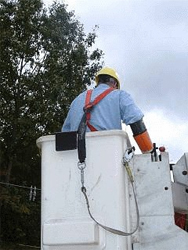
- No fall protection harness. OSHA requires fall protection for any work above 6 feet. Bucket truck baskets have harness anchor points for exactly this scenario. The worker was unrestrained.
- Using a jib to lift a fixed structure. A jib crane is rated for discrete, free-hanging loads under 500 – 1,000 lbs. A traffic signal mast arm is steel bolted to a concrete foundation – the force increases with deflection, far exceeding jib capacity.
- Worker in the bucket during a high-load lift. The catapult effect – exactly what happened – is a known and documented hazard. The boom stores energy like a spring and releases it violently when the load breaks free.
- Route planning failure. The oversized load should never have reached this intersection without the clearance issue being addressed in advance.
What OSHA Requires for Aerial Lifts
- 29 CFR 1926.453(b)(2)(v) – Body harness and lanyard attached to the boom or basket at all times
- 29 CFR 1926.501(b)(1) – Fall protection required at 6 feet or more above a lower level
- Restraint lanyards recommended – Short enough to prevent ejection, not just arrest a fall after it
- Employer responsibility – Employer must provide equipment, ensure it’s worn, and train workers. Failure is an employer violation.
How We Handle Fall Protection at BHE
We do this kind of work. We work from bucket trucks, boom lifts, ladders, and rooftops. When we see an incident like this, we don’t think “that guy was careless.” We think: “that could be any of us on the wrong day with the wrong shortcut.” When operating high-voltage or complex installations, performing a thorough farm electrical safety audit is the first step to mapping utility lines and avoiding structural contact.
- Harness on before the bucket goes up. Every time. No exceptions. Even for “just a second.”
- Equipment inspected before every use. Harnesses, lanyards, and anchors checked for wear and damage each shift.
- No improvised lifting. If the equipment isn’t rated for it, we stop and get the right tool.
- Right to refuse unsafe work. Any crew member can refuse a task they believe is unsafe. The job is never more important than going home.
Fall Protection FAQ
Yes. OSHA standard 29 CFR 1926.453(b)(2)(v) requires workers in aerial lifts to wear a body harness with a lanyard attached to the boom or basket at all times. This applies to boom trucks, bucket trucks, cherry pickers, and all MEWPs.
The catapult effect occurs when a boom under tension is suddenly released, causing it to whip violently. This can happen when a boom snags on an obstruction, a jib line snaps, or a tire drops off a curb while extended. The force can eject an unrestrained worker at high velocity. A restraint lanyard is the primary defense.
Boom trucks with a jib crane can lift loads within rated capacity – typically 500 to 1,000 lbs. The jib is designed for free-hanging loads like transformers and crossarms, not fixed structures bolted to the ground. Lifting a fixed structure creates a spring-load that increases with deflection, quickly exceeding capacity.
Ask about fall protection policy and training. Look for documented training, inspected harnesses, a written safety program, and a culture where workers can refuse unsafe tasks. If you see a contractor working at height without fall protection, that tells you everything about their standards on work you can’t see.
Bright Haven Electric – Safety-First Electrical Work
Licensed, insured, and safety-trained electrical services across West Central Minnesota.
Need Electrical Work Done Right – and Safe?
No shortcuts. No improvisation. Just professional work from a crew that takes safety personally.
Chadwick Ferguson
Chadwick Ferguson is the owner and licensed Master Electrician behind Bright Haven Electric LLC, serving West Central Minnesota from his base in Milan, MN. With deep expertise in residential, commercial, and agricultural electrical systems, he specializes in modern energy solutions including Level 2 EV charger installations, automatic standby generators, and comprehensive electrical panel upgrades.
Chadwick is committed to providing safe, code-compliant, and reliable electrical work to his rural Minnesota community. As the author of the BHElectric blog, he shares practical insights and expert guidance to help homeowners and businesses navigate the complexities of their electrical systems.