
 Chadwick Ferguson
Apr 28, 2026
Chadwick Ferguson
Apr 28, 2026
Pole Barn & Outbuilding Wiring Guide
Sub-panel sizing, underground feeder runs, circuit planning, and NEC code requirements for pole barns, shops, and outbuildings in West Central Minnesota.
Every spring and summer across West Central Minnesota, property owners build pole barns, machine shops, detached garages, and agricultural outbuildings. The structure goes up fast – but the electrical service is where most projects stall, get quoted wrong, or end up with code violations that fail inspection. Pole barn wiring isn’t the same as house wiring. The distances are longer, the loads are heavier, the environment is harsher, and the NEC requirements are specific.
This guide covers what you need to know before the electrician arrives – and what a licensed pole barn electrician should be doing when they get there. Whether you’re building a 30×40 hobby shop or a 60×120 machine shed with three-phase welders, the fundamentals are the same. Get the service right, size the feeder correctly, plan your circuits before the slab is poured, and you’ll have an outbuilding that works as hard as you do.
Bright Haven Electric has wired pole barns, shops, and agricultural outbuildings across our 10-county service area for over two decades. This guide reflects what we see in the field – not theory from a textbook.
Planning Your Outbuilding Electrical Service
The single most important decision in pole barn wiring happens before a single wire is pulled: how much power do you need – now and in five years? Undersizing the service to save money today guarantees an expensive upgrade later. Here is how to think about it:
Sub-Panel Sizing
A hobby shop with lighting and a few outlets needs a 60-amp sub-panel minimum. A working shop with a welder, air compressor, and dust collection needs 100 amps. A full machine shop or agricultural building with three-phase equipment typically requires 200 amps or a dedicated transformer. Always size for what you’ll need in five years – not what you need today. For high-demand farm shops or grain-handling sites, integrating dedicated irrigation VFD upgrades provides critical energy savings and voltage stabilization.
Size for GrowthUnderground Feeder Runs
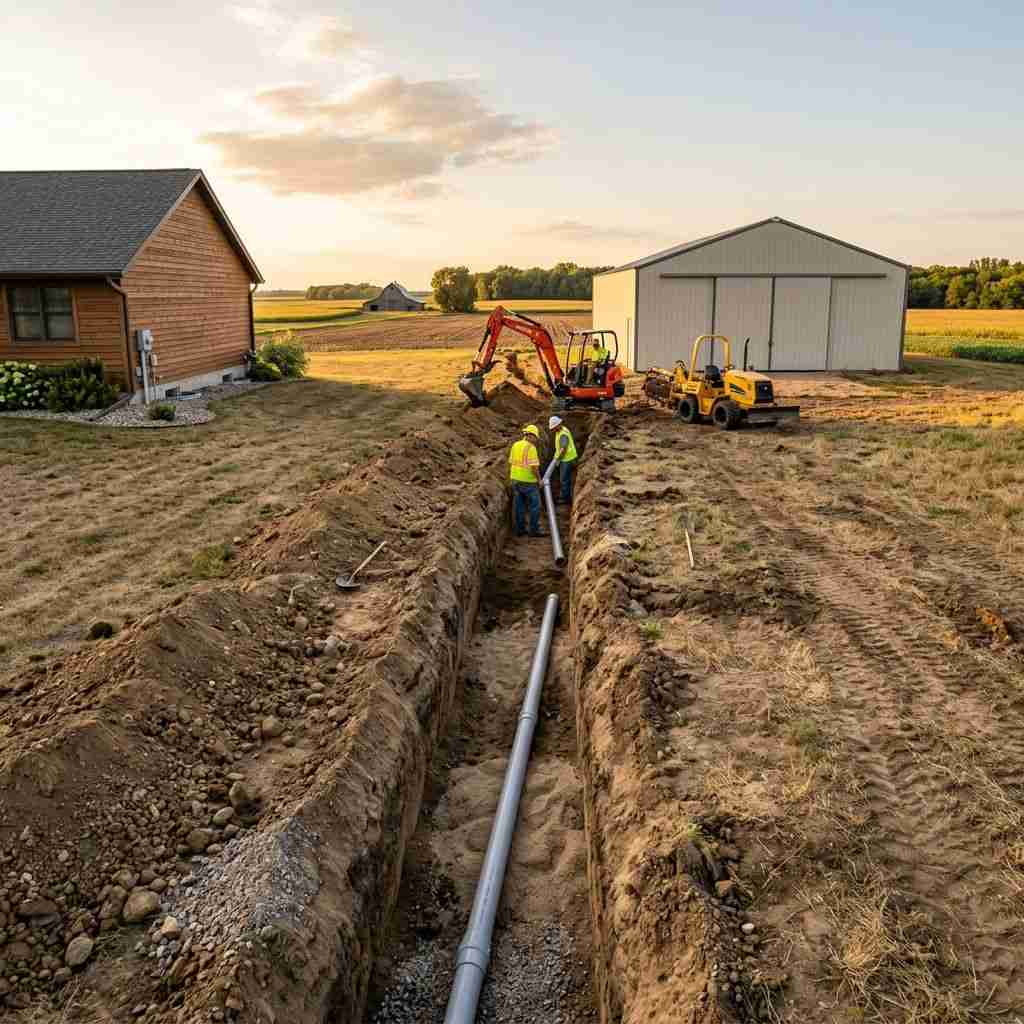
Most pole barns require an underground feeder from the house panel or meter to the outbuilding sub-panel. NEC requires direct-burial cable (UF-B) at 24″ depth minimum, or conduit (PVC Schedule 40 or rigid) at 18″ minimum. Longer runs mean larger wire to compensate for voltage drop – a 200-foot run at 100 amps typically requires 1/0 AWG copper or 2/0 aluminum.
Voltage Drop MattersCircuit Planning
Plan your circuits before the concrete is poured and the metal is up. Welding outlets (50A/240V), air compressor (30A/240V), dust collection, overhead lighting, convenience outlets, and exterior security lighting all need dedicated or shared circuits planned from the start. Running conduit through a finished pole barn ceiling is ten times harder than stubbing it up through the slab.
Plan Before You PourGrounding & Bonding
Outbuilding sub-panels require a separate grounding electrode system – typically two ground rods driven at least 6 feet apart. The neutral and ground buses must be separated in the sub-panel (unlike the main panel). This is the most commonly failed inspection item on outbuilding wiring. Metal buildings also require bonding of the steel frame to the grounding system.
Top Inspection Failure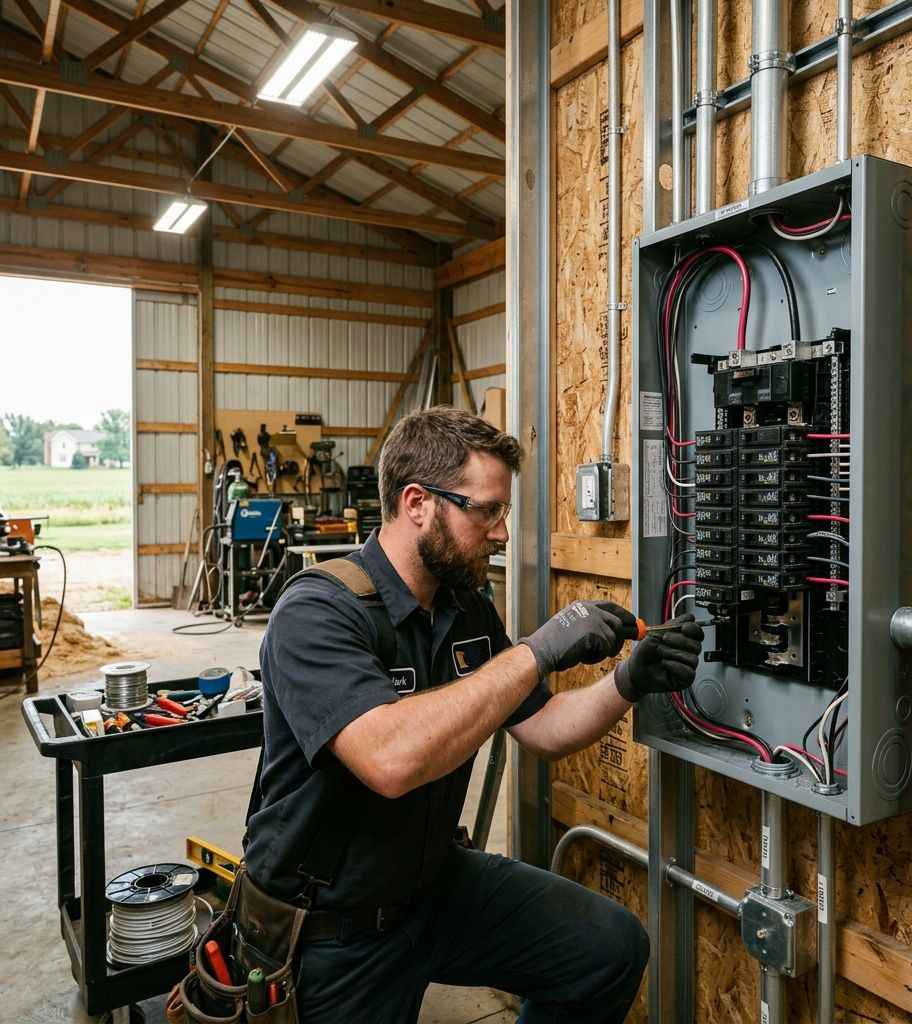
Common Pole Barn Electrical Configurations
Not every pole barn needs the same service. Here are the four most common configurations we install across West Central Minnesota, from basic to full commercial:
Configuration 1: Basic Hobby Shop (60A Service)
The Weekend Workshop
For woodworking, small projects, vehicle storage with lighting, and seasonal use. Typical building: 24×32 to 30×40.
- 60-amp sub-panel – 12 to 16 spaces, fed from the house main panel
- 4 – 6 general-purpose 20A circuits – outlets around the perimeter at workbench height
- 2 dedicated lighting circuits – overhead LED high-bays and task lighting
- 1 exterior circuit – security lighting and a weatherproof outlet
- GFCI protection – required on all receptacles in an unfinished building (NEC 210.8)
Configuration 2: Working Shop (100A Service)
The Serious Workshop
For welding, fabrication, automotive work, and heavy-duty power tools. Typical building: 30×50 to 40×60.
- 100-amp sub-panel – 20 to 30 spaces, dedicated feeder from the meter or main panel
- 1 – 2 welding outlets (50A/240V NEMA 6-50) – dedicated circuits for MIG, TIG, or stick welders
- 1 air compressor circuit (30A/240V) – for a 5 – 7.5 HP stationary compressor
- 6 – 8 general-purpose 20A circuits – outlets on all walls, including ceiling drops
- Dust collection circuit (20A/240V) – if running a central dust system
- LED high-bay lighting – 2 circuits, typically 8 – 12 fixtures for proper coverage
- Exterior security lighting – motion-activated LED floods on all four corners
Configuration 3: Agricultural Building (200A Service)
The Farm Machine Shop
For full-scale farm operations – equipment maintenance, grain handling support, livestock infrastructure. Typical building: 40×80 to 60×120.
- 200-amp sub-panel or dedicated meter – may require utility coordination for a new service drop
- Multiple 240V circuits – welders, plasma cutters, hydraulic presses, and large compressors
- Three-phase power – required for equipment like large lathes, milling machines, and grain handling motors
- Phase converter or VFD – if utility three-phase isn’t available at the site (common in rural MN)
- Agricultural ventilation circuits – exhaust fans, heaters, and environmental controls
- Fuel pump and grain dryer circuits – dedicated, code-compliant, with proper disconnect switches
- Explosion-proof fixtures – required in areas with combustible dust or fuel vapors per NEC Article 500
Configuration 4: Commercial Outbuilding (200A+ / 3-Phase)
The Commercial Operation
For commercial shops, fleet maintenance, contract manufacturing, or agricultural processing. Requires engineered plans and utility coordination.
- 400-amp+ service or dedicated transformer – utility will size based on your load calculation
- Three-phase distribution panel – for motors, CNC equipment, and industrial compressors
- Fire alarm and emergency lighting – required for commercial occupancy per Minnesota State Building Code
- Code-required disconnects – at all equipment, at the building entrance, and at the meter
- Engineered load calculation – required by the State Electrical Inspector before the permit is issued
“The number one mistake I see is someone who builds a beautiful 40×60 shop, puts in a 60-amp panel to save a few hundred dollars, and then calls us a year later because they can’t run their welder and compressor at the same time. We upgrade more undersized outbuilding panels than anything else. Size it right the first time – the wire in the ground is the expensive part, not the panel.” – Chadwick Ferguson, Master Electrician & Co-Owner, Bright Haven Electric LLC
NEC Code Requirements for Outbuilding Wiring
Minnesota enforces the 2023 National Electrical Code (NEC) statewide. Pole barns, detached garages, and agricultural outbuildings fall under specific NEC articles that differ from residential house wiring. Here are the code requirements that matter most:
Critical NEC Articles for Outbuildings
- Separate grounding electrode required (NEC 250.32). Every detached building with a sub-panel must have its own grounding electrode system – minimum two ground rods, 8 feet long, driven at least 6 feet apart. The neutral and ground buses must be isolated in the sub-panel. This isn’t optional and is the most common inspection failure.
- GFCI protection on all 125V receptacles (NEC 210.8). In unfinished spaces – which includes most pole barns – every 15A and 20A, 125V receptacle requires GFCI protection. This applies to interior and exterior outlets. Use GFCI breakers in the sub-panel for the cleanest installation.
- Disconnecting means at the building (NEC 225.31). The outbuilding must have a disconnect switch or main breaker at or near the point where the feeder enters the building. A main-breaker sub-panel satisfies this requirement. A main-lug-only panel doesn’t – you would need a separate disconnect.
- Underground feeder burial depth (NEC Table 300.5). Direct-burial UF-B cable requires 24″ minimum cover. PVC conduit requires 18″ minimum. Rigid metal conduit requires 6″ minimum. Under driveways, concrete, or areas subject to vehicle traffic, add 6″ to all minimums. We always recommend conduit over direct burial – it protects the wire and allows future upgrades without re-trenching.
- Voltage drop calculation (NEC 210.19 Informational Note). NEC recommends no more than 3% voltage drop on branch circuits and 5% total from the utility transformer to the outlet. On a 200-foot run, this often requires upsizing the feeder conductor by one or two sizes. A 100-amp feeder at 200 feet in aluminum typically needs 2/0 AWG minimum – not the #2 that ampacity tables alone would allow.
- Agricultural building requirements (NEC Article 547). Buildings housing livestock, storing hay, or handling grain are classified as agricultural buildings and require specific wiring methods: dust-tight and corrosion-resistant equipment, proper separation of grounding and bonding conductors, and equipotential bonding planes in livestock confinement areas to prevent stray voltage.
5 Costly Mistakes to Avoid
After wiring hundreds of outbuildings, we see the same mistakes repeated. Each one costs more to fix after the fact than it would have cost to do correctly from the start:
Undersized Service
Installing a 60-amp panel when a 100-amp is needed saves $200 today and costs $3,000 to upgrade later – because the underground feeder has to be replaced too. The panel itself is the cheapest component. The trench and wire are the expensive parts. Size it right once.
Most Common MistakeNo Permit or Inspection
Minnesota requires an electrical permit for all new outbuilding wiring. Skipping the permit means no inspection – which means no one checks whether the grounding, feeder sizing, and GFCI protection meet code. Insurance companies can deny fire claims on unpermitted electrical work. It isn’t worth the risk.
Insurance RiskBonding the Neutral in the Sub-Panel
In a sub-panel, the neutral bus and ground bus must be separated – the bonding screw or strap must be removed. Bonding neutral to ground in a sub-panel creates parallel paths for current on the grounding conductor, which can energize metal building frames and cause stray voltage on livestock operations.
Shock & Stray Voltage HazardIgnoring Voltage Drop
A 150-foot underground run with undersized wire delivers low voltage to your equipment. Your welder arcs weakly, your compressor motor overheats, and your LED lights flicker. Voltage drop isn’t a suggestion – it’s physics. Calculate it before you buy wire, or your electrician will do it for you.
Equipment Damage RiskPoor Lighting Layout
Putting two light fixtures in a 40×60 shop creates shadows everywhere you actually work. LED high-bays are inexpensive – plan for 50+ lumens per square foot in work areas. Mount them on separate circuits from outlet circuits so a tripped breaker doesn’t leave you in the dark with a running saw.
Easy to Get RightA Note on DIY Pole Barn Wiring
- Minnesota law allows homeowners to wire their own primary residence – but outbuildings and detached structures still require a licensed electrician in many jurisdictions
- Even where homeowner wiring is permitted, the State Electrical Inspector still inspects the work to the same NEC standard as a licensed contractor
- Sub-panel installations, underground feeder runs, and three-phase work involve calculations and techniques that aren’t covered in DIY guides – mistakes create fire and shock hazards that may not be apparent for months or years
- Insurance companies increasingly require proof of permitted, inspected electrical work for outbuilding coverage – unpermitted work can void your policy
Pole Barn Electricians – West Central Minnesota
Bright Haven Electric LLC wires pole barns, machine shops, and agricultural outbuildings across West Central Minnesota. From a 30×40 hobby shop near Glenwood to a 60×120 machine shed outside Granite Falls, we handle the full scope – underground feeder, sub-panel, circuits, lighting, and inspection coordination.
We serve property owners across our 10-county service area:
Building a Pole Barn? Get the Electrical Right.
From sub-panel sizing to underground feeder runs, we handle the full scope of outbuilding electrical – permitted, inspected, and built to last. Request a quote before you break ground.
It depends on how you use the building. A basic hobby shop needs a 60-amp sub-panel minimum. A working shop with a welder and compressor needs 100 amps. An agricultural building or machine shop with three-phase equipment typically requires 200 amps or more. Always size for future use – upgrading the underground feeder later costs significantly more than installing the right size initially. A licensed electrician will perform a load calculation to determine the correct size for your specific equipment list.
Per the 2023 NEC Table 300.5, direct-burial cable (UF-B) requires a minimum of 24 inches of cover. PVC conduit requires 18 inches minimum. Rigid metal conduit requires only 6 inches. Under driveways or areas with vehicle traffic, add 6 inches to all minimums. We recommend PVC conduit over direct burial because it protects the wire from damage and allows future conductor upgrades without re-trenching.
Yes. Minnesota requires an electrical permit for all new outbuilding wiring, including pole barns, detached garages, and agricultural buildings. The work must be inspected by the Minnesota State Electrical Inspector and pass to the current NEC code. Skipping the permit means no inspection – and insurance companies can deny claims on unpermitted electrical work. Contact Bright Haven Electric and we handle the permit process as part of the project.
Yes. Per NEC 250.32, every detached building with a sub-panel requires its own grounding electrode system – typically two ground rods, 8 feet long, driven at least 6 feet apart. The neutral bus and ground bus in the sub-panel must also be separated (the bonding screw must be removed). This is the most commonly failed inspection item on outbuilding wiring projects.
Costs vary significantly based on the service size, feeder run distance, and circuit count. A basic 60-amp hobby shop with a short underground run typically costs $2,500-$4,500. A 100-amp working shop with welding outlets runs $5,000-$9,000. A 200-amp agricultural building with three-phase power can range from $10,000-$20,000+ depending on equipment requirements and utility coordination. Request a detailed estimate – we provide transparent, itemized quotes for every project.
Chadwick Ferguson
Chadwick Ferguson is the owner and licensed Master Electrician behind Bright Haven Electric LLC, serving West Central Minnesota from his base in Milan, MN. With deep expertise in residential, commercial, and agricultural electrical systems, he specializes in modern energy solutions including Level 2 EV charger installations, automatic standby generators, and comprehensive electrical panel upgrades.
Chadwick is committed to providing safe, code-compliant, and reliable electrical work to his rural Minnesota community. As the author of the BHElectric blog, he shares practical insights and expert guidance to help homeowners and businesses navigate the complexities of their electrical systems.