
 Chadwick Ferguson
Mar 20, 2026
Chadwick Ferguson
Mar 20, 2026
How to Reset a GFCI Outlet & Tripped Breaker
Dead outlets, tripped breakers, and switches that don’t seem to do anything – this step-by-step troubleshooting guide covers the fixes most homeowners get wrong.
Most homeowners know they need to “flip the breaker” or “press the button” when an outlet stops working. However, when the standard fix doesn’t work, most people are stuck. Learning how to properly reset a GFCI outlet and tripped breaker is one of the most practical electrical skills a homeowner can have – and getting it wrong can mean hours of unnecessary frustration or an avoidable service call.
This guide walks you through the correct reset procedures step by step, then covers six real-world troubleshooting scenarios where GFCIs, breakers, and switches interact in ways that confuse even experienced homeowners. If you want to understand the deeper theory behind how breakers actually work, see our companion post: Circuit Breaker Tripping: Overloads & Short Circuits.
How to Reset a GFCI Outlet
Time needed: 10 minutes
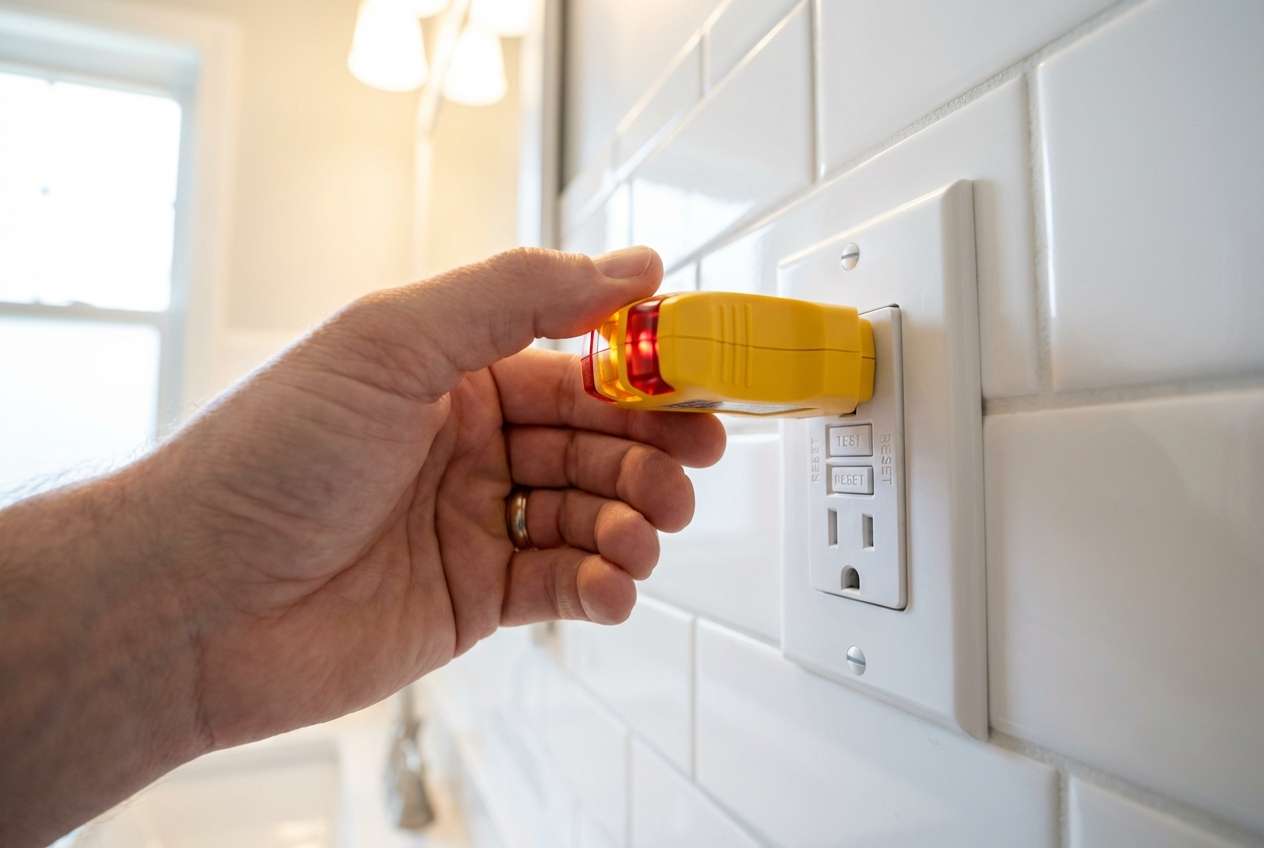
A GFCI (Ground Fault Circuit Interrupter) outlet protects you from electrical shock by shutting off power when it detects current leaking to ground. When it trips, the RESET button pops out and all outlets protected by that GFCI go dead. As a result, a dead outlet in your bathroom may actually be controlled by a GFCI in your kitchen or garage. Here’s how to reset a GFCI outlet correctly:
- Locate the GFCI Outlet
The GFCI protecting a dead outlet may not be in the same room. Check bathrooms, kitchens, garages, basements, and outdoor outlets for the distinctive rectangular buttons labeled TEST and RESET. In particular, one GFCI can protect multiple outlets downstream – so the culprit might be two rooms away.
- Check the Indicator Light
Many modern GFCIs have a small LED indicator. A green light typically means the outlet has power and is protecting correctly. A red light or no light usually means the GFCI has tripped or lost power. Consequently, this is the fastest way to confirm you’ve found the right GFCI.
- Press RESET Firmly
Push the RESET button in firmly until you hear and feel a solid click. If the button won’t stay in, the GFCI is either still detecting a fault or it has no power – see Troubleshooting Scenario 1 below.
- Test the Outlet
Plug in a lamp or use a GFCI outlet tester to confirm power has been restored. Plus, check any downstream outlets that were also dead – they should all be live again.
- Verify the Protection Works
Press the TEST button – the GFCI should trip immediately and kill power. This confirms the protection mechanism is functioning. Then press RESET again to restore power. You should test your GFCIs monthly to ensure they’re still protecting you.
How to Reset a Tripped Circuit Breaker
When a circuit breaker trips, it doesn’t go fully to the OFF position. Instead, the handle moves to a middle position – between ON and OFF. This is the detail most homeowners miss, and it’s the reason the breaker “won’t go back on.” Here’s the correct procedure to reset a tripped breaker:
Find the Tripped Breaker
Open your breaker panel door. Look for the breaker with its handle in the middle position – it won’t be lined up with the others. In some panels, a small orange or red indicator may also be visible on the tripped breaker.
Push the Handle Firmly to OFF
This is the step most people skip. You must push the handle all the way past the middle position to the full OFF position first. You’ll feel and hear a mechanical click – that’s the internal trip mechanism resetting its latch. Without this step, the breaker can’t re-engage.
Push the Handle Back to ON
Now push the handle firmly from OFF to ON. The breaker should stay in the ON position and power should be restored to the circuit.
If It Trips Again Immediately – Stop
If the breaker trips again the moment you flip it back on, don’t keep resetting it. A breaker that trips immediately indicates an active fault on the circuit – a short circuit, ground fault, or failed device. Repeated forced resets can damage the breaker and escalate the hazard. Instead, call a licensed electrician.
6 Scenarios That Stump Most Homeowners
The procedures above work for straightforward trips. However, electrical systems are interconnected – and in real homes, GFCIs, breakers, and switches interact in ways that create confusing problems. Below are six real-world scenarios we encounter regularly on service calls across West Central Minnesota.
Tripped Breaker + Downstream GFCI Won’t Reset
What you see:
A breaker tripped. You reset it (OFF → ON). But now a GFCI outlet downstream on that same circuit is dead, and pressing RESET does nothing – the button won’t click in.
Why this happens:
When the breaker tripped, the GFCI lost power and tripped simultaneously. Because a GFCI needs line voltage flowing through it to re-engage its internal sensing circuit, it can’t reset without power. As a result, if you try to reset the GFCI while the breaker is still tripped, the button won’t latch.
The fix: Reset the breaker first (OFF → ON) to restore power to the circuit. Then go to the GFCI and press RESET. It should now click in and restore power to everything downstream.
The Breaker Handle Won’t Stay On
What you see:
The breaker handle is sitting in a weird middle position – not ON, not OFF. You push it toward ON, but it immediately springs back to the middle.
Why this happens:
When a breaker trips, the internal trip mechanism moves to a latched “tripped” state. The handle lands in the middle position as a visual indicator. However, pushing directly from the middle toward ON does not reset the internal latch – so the mechanism blocks re-engagement and the handle springs right back.
The fix: Push the handle firmly past the middle to full OFF. You’ll feel a distinct mechanical click – that’s the trip mechanism resetting. Only then can you push it back to ON. This is the single most common breaker reset mistake homeowners make.
Two GFCIs on the Same Circuit – Upstream Blocks Downstream
What you see:
An outlet goes dead. You find a GFCI in the kitchen and press RESET – it clicks in, but the dead outlet still has no power. You check the breaker panel and nothing is tripped.
Why this happens:
There’s a second GFCI wired upstream on the same circuit – often in the garage, basement, or another bathroom. Because of a wiring error, one GFCI is installed in the “load” path of the other, putting them in series. When the upstream GFCI trips, everything downstream loses power – including the downstream GFCI, which can’t reset without voltage from its own line terminals.
The fix: Find and reset the GFCI that’s first on the circuit. If you don’t know which one is upstream, reset every GFCI in the house – kitchens, bathrooms, garage, basement, outdoors. The upstream reset restores power to everything downstream.
Pro tip: Two GFCIs in series is almost always a wiring error from a previous installer. Call a licensed electrician to correct the circuit so each GFCI only protects its own downstream outlets.
The 3-Way Switch That Only Works From One End
What you see:
You’ve a light controlled by two switches – one at the top of the stairs and one at the bottom (or each end of a hallway). The light works fine from one switch, but the other switch does nothing. Or it only works when the other switch happens to be in a certain position.
Why this happens:
A 3-way switch works by routing power through one of two internal “traveler” paths. Both switches must work together to complete the circuit. When the internal wiper contact inside one switch wears out or loses reliable contact with one of the two traveler terminals, the circuit only completes in certain switch-position combinations. In other positions, the electricity has no path and the light stays dark.
The fix: This is not a DIY fix – it requires replacing the defective 3-way switch and verifying the traveler wiring is correct. Improperly wired 3-way circuits can also create a shock hazard. Call a licensed electrician to diagnose and replace the failing switch.
A Light Switch That Kills the Entire Circuit
What you see:
Multiple outlets and lights go dead simultaneously – but nothing is tripped in the breaker panel. Everything seems fine at the panel. The problem comes and goes seemingly at random.
Why this happens:
Somewhere in the circuit, a wall switch is installed on the hot (line) conductor feeding the entire branch circuit – not just a single light fixture. This is sometimes called “switched power.” When someone flips that switch off (perhaps in a hallway, closet, or entryway), it cuts power to every device wired downstream of it. Because the breaker panel shows no trip, homeowners assume it’s a panel or wiring failure when it’s just a switch.
The fix: Flip every wall switch in the affected area. One of them is feeding – or killing – the entire circuit. Once you’ve identified it, a licensed electrician can re-wire the circuit so the switch only controls the intended light fixture, giving the rest of the circuit constant power.
The Mystery Switch & the Half-Hot Outlet
What you see:
There’s a switch on the living room wall that doesn’t seem to do anything – no light turns on, no fan responds, nothing visible happens. Meanwhile, a nearby duplex outlet only works on the bottom receptacle; the top half is always dead no matter what you plug in.
Why this happens:
This is actually a code-compliant, intentional design called a “half-hot” or “split” outlet – and it’s extremely common in rooms without a ceiling light fixture. During installation, the electrician broke the metal tab between the two brass screws on the receptacle, separating the top and bottom into two independent circuits. The bottom half gets constant (always-on) power. The top half is wired through the wall switch – designed for a floor lamp. Because nobody ever plugged a lamp into the top, the switch appears to “do nothing.”
The fix: Flip the mystery switch, then plug a lamp into the top receptacle of the nearby outlet – it should light up. This is working as designed. If you’d prefer the entire outlet to be always-on and don’t need the switch, an electrician can remove the switch from the circuit, reconnect the tab, and give you a full always-on duplex outlet.
Pro tip: If you find a switched outlet that isn’t working, check whether the tab between the top and bottom brass screws has been broken. A broken tab is the telltale sign of a half-hot configuration – and it means the two halves are on separate circuits intentionally.
When to Call an Electrician
Most of the fixes above are safe for homeowners to try. However, the following situations require a licensed electrician – don’t attempt to diagnose these yourself:
- A breaker that trips immediately every time you reset it
- A burning smell coming from your breaker panel or any outlet
- Scorch marks or discoloration on a breaker, bus bar, or outlet face
- A GFCI that won’t reset even with power confirmed at the line terminals
- Two GFCIs wired in series that keep interfering with each other
- A 3-way switch that fails intermittently in certain positions
- An upstream switch that kills power to an entire circuit
- Any situation where you smell ozone, burning plastic, or see sparks
Related Guides
- Circuit Breaker Tripping: Overloads & Short Circuits – Deep dive into thermal vs. magnetic trip mechanisms.
- AFCI Breakers: How They Prevent Home Electrical Fires – How arc fault interrupters differ from GFCIs.
- Understanding Your Home Electrical System – A full overview of panels, circuits, grounding, and more.
- Electrical Shock Prevention Guide – How to protect your family from electrocution hazards.
- Storm Electrical Safety: Before & After Tips – GFCI and breaker procedures after storm damage.
A GFCI (Ground Fault Circuit Interrupter) is designed to shut off power in milliseconds if it senses electricity leaking out of its intended path – which usually means it’s trying to go through water, or worse, through you.
If it keeps tripping, you usually have one of three things going on:
Moisture: Back in Seattle, it was the rain; out here in Minnesota, it’s often snowmelt getting into outdoor boxes.
A bad appliance: Whatever you’re plugging into it (a coffee maker, power tool, or hairdryer) might have an internal short. Try unplugging everything to see if it holds.
The outlet is worn out: GFCIs don’t last forever. After 10 to 15 years, the internal circuitry goes bad and they become overly sensitive or fail entirely.
When a breaker is sitting in the middle (spongy) position, it means it has tripped. It detected an overload or a short circuit and did its job to prevent a fire. To fix it, you can’t just push it toward “ON.” You’ve to push the lever firmly all the way to the “OFF” position until you feel a click, and then firmly snap it back to the “ON” position. If it trips again immediately, leave it off and call a professional – you’ve got a dead short somewhere.
Legally? If you own the home and live in it, Minnesota generally allows homeowners to do their own electrical work. Should you? That depends entirely on your comfort level.
Replacing a GFCI isn’t like replacing a standard outlet. You absolutely must understand the difference between the LINE terminals (bringing power in from the panel) and the LOAD terminals (feeding power to other outlets downstream). If you wire them backward – which I’ve seen DIYers do a thousand times – the outlet might have power, but it won’t protect you from a deadly shock. If you aren’t 100% confident with a multimeter and wiring diagrams, call us at Bright Haven Electric.
This is a classic “handyman special.” When you’ve two GFCIs wired on the same circuit (specifically, if one is wired into the LOAD side of another), they fight each other. We call it “phantom tripping.” If there’s a minor fluctuation, both might trip, and you’ll be running all over the house trying to figure out how to reset your power. You only need one GFCI at the beginning of the circuit to protect all the standard outlets downstream.
The manufacturers and Underwriters Laboratories (UL) recommend testing them once a month. Just push the “TEST” button. You should hear a loud click, and the power to anything plugged in should die. Then push “RESET” to turn it back on. If you press test and the power stays on, the outlet is broken and needs to be replaced immediately.
You’re talking about a 3-way switch setup (like at the top and bottom of a staircase). If they only work when one switch is in a specific position, somebody wired it wrong, or one of the switches has failed internally. In a 3-way switch, you’ve a “Common” wire and two “Traveler” wires. If a DIYer mixed up the common wire with one of the travelers during a remodel, it breaks the circuit logic. It’s an easy fix for a seasoned sparky, but can be a real headache to trace if you don’t know what you’re looking for.
A half-hot (or switched) outlet is a standard duplex receptacle where one half (usually the bottom plug) has constant power for things like alarm clocks or phone chargers, and the other half (usually the top plug) turns on and off with a wall switch. We install these all the time in bedrooms and living rooms that don’t have overhead ceiling lights so you can control a floor lamp right when you walk in the door.
Still Stumped? We Can Help.
If you’ve tried the troubleshooting steps above and the problem persists – or if something doesn’t feel right – don’t take chances. Bright Haven Electric LLC provides expert electrical troubleshooting throughout West Central Minnesota.
Chadwick Ferguson
Chadwick Ferguson is the owner and licensed Master Electrician behind Bright Haven Electric LLC, serving West Central Minnesota from his base in Milan, MN. With deep expertise in residential, commercial, and agricultural electrical systems, he specializes in modern energy solutions including Level 2 EV charger installations, automatic standby generators, and comprehensive electrical panel upgrades.
Chadwick is committed to providing safe, code-compliant, and reliable electrical work to his rural Minnesota community. As the author of the BHElectric blog, he shares practical insights and expert guidance to help homeowners and businesses navigate the complexities of their electrical systems.