
 Chadwick Ferguson
Apr 23, 2026
Chadwick Ferguson
Apr 23, 2026
SPAN Panel Goes Open:
Local API, On-Premise Dashboard, and Eaton Partnership
What April 2026’s biggest smart panel announcements mean for Minnesota homeowners – from a certified SPAN installer who has been waiting for this.
Why This Is a Big Deal
Until now, smart electrical panels have been walled gardens. You buy the panel, your data goes to the manufacturer’s cloud, and you access it through their app. You can’t export it. You can’t integrate it. You can’t build on top of it. The panel is in your home, but the data lives on someone else’s server.
SPAN just changed that. In April 2026, they released three announcements that, together, represent the most significant shift in smart panel technology since the category was created:
SPAN API
A public, documented local API that lets homeowners access their panel data directly over their home network. No cloud. No middleman. Your panel, your data.
Public Beta – Available NowSPAN Home On-Premise
A browser-based local dashboard that works during power outages – no internet required. Monitor circuits, toggle loads, and manage backup priorities from any device on your network.
Works OfflineSPAN × Eaton
Eaton – one of the most trusted names in electrical distribution – now offers smart panels with SPAN Energy Intelligence inside. Same technology, broader availability.
More Options for Buyers“It only took me 5.5 years to make that happen!” – Don Jackson, SPAN, responding to the API release on social media (April 23, 2026)
When the person who built the feature says it took half a decade, you know it was a priority – and you know it was done right. This isn’t a rushed afterthought. It’s a deliberate architectural decision to give homeowners ownership of their energy data.
What the SPAN API Actually Does
The SPAN API is a local-only integration interface that runs directly on your SPAN Panel. It uses MQTT – the same lightweight messaging protocol used in industrial automation and smart home platforms – over your home’s local area network. No data leaves your house.
SPAN API – Technical Overview
What Can You Do With It?
The API opens up integrations that were previously impossible without reverse-engineering or unofficial workarounds:
- Home Assistant integration – monitor every circuit in your panel from your existing smart home dashboard. See which circuits are drawing power, set automations based on energy usage, and get alerts when loads exceed thresholds.
- Grafana dashboards – store historical energy data locally and build detailed charts showing consumption patterns over days, weeks, and months. Compare your solar production to grid consumption in real time.
- Custom automations – automatically shed non-essential loads during peak pricing windows. Turn off the EV charger when the dryer is running. Prioritize battery backup for critical circuits during outages.
- Per-circuit control – remotely toggle individual circuit relays through the API. Turn off the barn lights from your phone without a separate smart switch.
- Multi-system coordination – tie your SPAN Panel data into your solar inverter, battery system, and EV charger for unified energy management across your entire property.
A Note on Security and Privacy
The SPAN API runs entirely on your local network. Data never leaves your home unless you explicitly send it somewhere. Authentication is credential-based and locally controlled – the homeowner decides who gets access. This is a fundamentally different model from cloud-dependent smart home devices that phone home to a manufacturer’s server.
SPAN’s documentation follows open standards (eBus/Homie), which means the integration framework isn’t proprietary to SPAN. Other manufacturers can adopt the same protocol, creating a path toward real interoperability between smart electrical devices.
SPAN Home On-Premise: Your Panel, Offline
The second major announcement is SPAN Home On-premise – a browser-based dashboard that connects directly to your SPAN Panel over your local network. No internet. No cloud. No app store download. Just open a browser on any device connected to your home Wi-Fi.
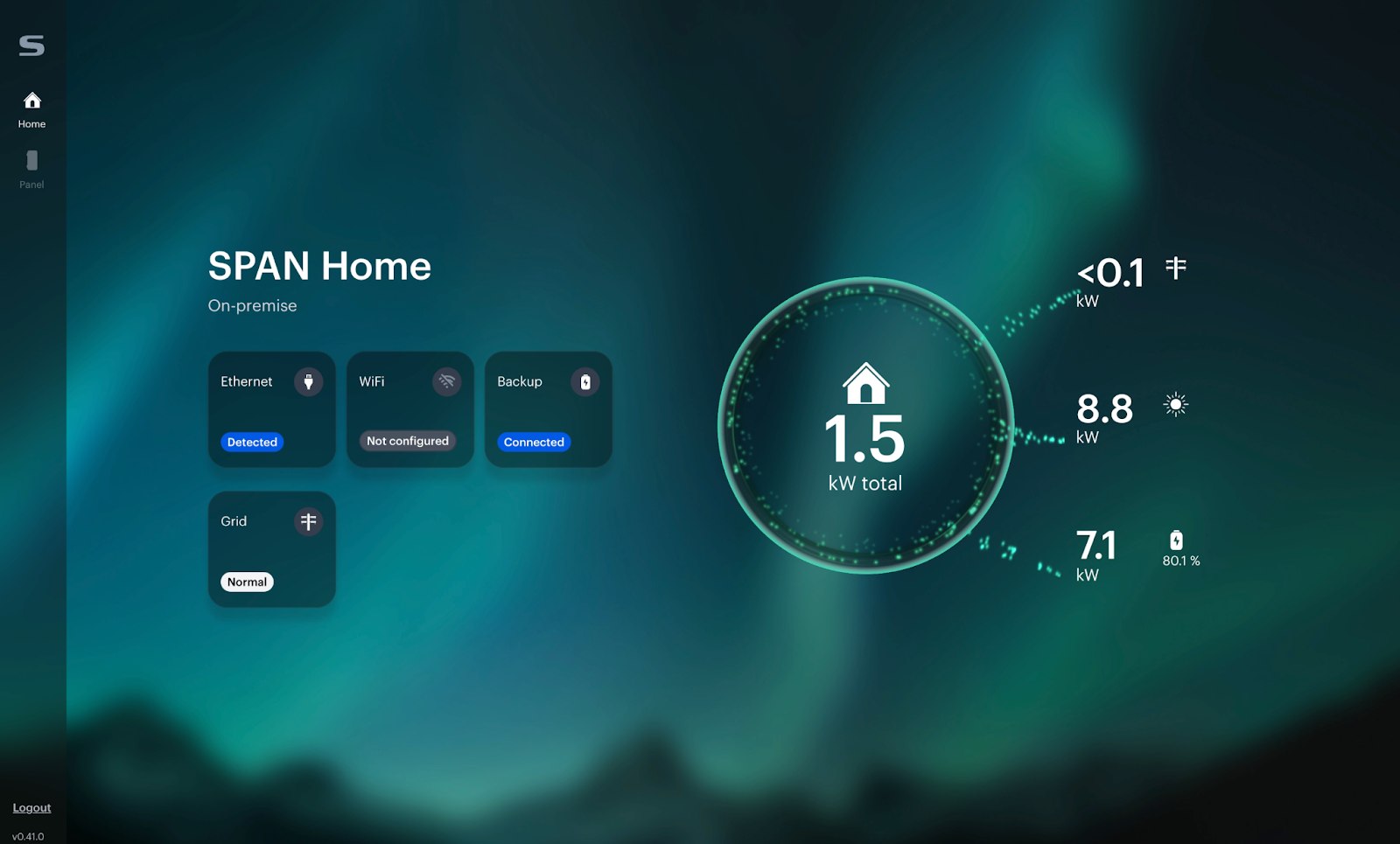
This matters enormously for rural Minnesota. During an extended power outage – the kind we get every winter – your internet goes down with the power. If you’ve battery backup, the SPAN Home On-premise app lets you:
- View overall panel status – grid connection, battery level, solar production at a glance
- Monitor circuit-level power usage – see exactly which circuits are drawing from your battery
- Turn circuits on and off – shed loads to extend battery life during a prolonged outage
- Adjust backup priorities – move circuits between “must stay on” and “shed if needed” categories in real time
Why This Matters for Rural MN
In West Central Minnesota, we regularly see winter storms that knock out power for 12 to 48 hours. Cell towers go down. Internet goes down. If your smart panel only works through a cloud app, you lose control of your home energy system at the exact moment you need it most.
SPAN Home On-premise solves this. If your panel has battery backup and your router is on a backed-up circuit, you’ve full local control of every circuit in your home – from your phone, tablet, or laptop – with zero internet dependency. This is how smart panels should work in rural areas.
SPAN × Eaton: What Changes for Buyers
The third announcement is a strategic collaboration between SPAN and Eaton – one of the most recognized names in electrical distribution. Eaton will now manufacture and distribute smart panels featuring SPAN Energy Intelligence™ technology through Eaton’s existing distribution channels.
Here is what that means in plain language:
More Options
You can install either an Eaton-branded or SPAN-branded smart panel and get the same core technology. Choose the model that works best for your home and your electrician’s preferred breaker line.
Wider Availability
Eaton’s distribution network means smart panels will be available at more electrical supply houses. Less lead time, more inventory, easier for your installer to source.
Same Installer Required
Both Eaton and SPAN-branded panels still require a SPAN Authorized Installer for commissioning. The smart features need proper configuration – this isn’t a DIY install.
Eaton Smart Panel Models
Eaton Smart Panels with SPAN Energy Intelligence will be available in MAIN 16, MLO 24, MAIN 40, and MLO 48 configurations through Eaton distribution channels. SPAN continues to manufacture its own line of panels independently. The SPAN Panel MAIN 32 – currently the only model with API support – remains a SPAN-branded product.
API support for Eaton’s models and SPAN’s additional models is expected in the second half of 2026.
Why We Are Watching This Closely
As a certified SPAN installer in West Central Minnesota, these announcements align with exactly what we’ve been asking for. Here is our perspective:
Local API access matters for rural homeowners. Most of our customers are on co-op power with variable rates, unreliable internet, and properties where a single panel might serve the house, the shop, and the barn. The ability to integrate a smart panel with Home Assistant or a local monitoring system – without depending on a cloud service – is a genuine upgrade in reliability.
The eBus/Homie framework is the right approach. SPAN didn’t invent a proprietary protocol. They adopted Electrification Bus (eBus), an open multi-vendor integration framework. That means when other manufacturers follow – and they’ll – the integrations you build today should work with tomorrow’s hardware.
Smart panels are no longer luxury items. With the Eaton partnership expanding distribution and the API giving homeowners real control over their data, smart panels are moving from “early adopter” territory into the mainstream. We expect demand to accelerate – especially for new construction and 200-amp service upgrades where you’re replacing the panel anyway.
Should You Get a Smart Panel?
A smart panel isn’t for everyone – yet. Here is a straightforward decision framework:
Strong Fit
- You’re building new or replacing a panel anyway – the incremental cost is lowest here
- You’ve solar, battery, or an EV charger and want unified monitoring of all three
- You run Home Assistant or another local smart home platform
- You want per-circuit control during outages with battery backup
- You’re on a co-op with variable or time-of-use rates and want to optimize consumption
Wait and See
- Your current panel is modern, safe, and has plenty of capacity
- You don’t have solar, battery, or EV charging (the ROI is lower without these)
- You want API access but don’t have a MAIN 32 – other models get API support in H2 2026
- Budget is the primary constraint – a standard panel upgrade at $2,500-$5,500 may be the better investment right now
What Does a SPAN Panel Cost in 2026?
An installed SPAN smart panel typically costs between $6,500 and $10,000+ in 2026, including the panel itself ($3,000-$5,500) and professional installation ($2,000-$6,000+). The final price depends on your electrical configuration – whether it’s a main panel upgrade, a subpanel installation, and how much existing work needs to be updated to accommodate the smart panel.
For context, a standard 200-amp panel replacement in West Central Minnesota typically runs $2,500-$5,500. The smart panel premium – roughly $3,000-$5,000 – gets you per-circuit monitoring, remote control, smart load management, and now an open API for custom integrations. For homes with solar, battery, or EV charging, the payback through energy optimization can be significant.
Smart Panel FAQ
Common questions about the SPAN Panel, the new API, and smart panel installations in Minnesota.
The SPAN Panel API is a local, LAN-based interface that lets homeowners and developers access their SPAN Panel data directly over their home network. It uses MQTT (a lightweight messaging protocol) following the Electrification Bus (eBus) framework. You can use it to integrate your panel with home automation platforms like Home Assistant, build custom energy dashboards with tools like Grafana, and automate load management based on real-time energy data. The API is currently available on the SPAN Panel MAIN 32 with firmware r202603 or later. It’s provided for personal, non-commercial use only.
Yes. The core SPAN Panel functions – circuit-level monitoring, relay control, and load management – operate independently of internet connectivity. The new SPAN Home On-premise app takes this further by providing a full browser-based dashboard that runs entirely on your local network. During a power outage with battery backup, you can monitor circuits, toggle loads, and adjust backup priorities from any device on your home Wi-Fi – even with zero internet access. This is especially valuable in rural Minnesota where internet outages often coincide with power outages.
Yes. The SPAN API was designed with home automation integration in mind. Because it uses MQTT – the same protocol Home Assistant already supports natively – you can subscribe to your panel’s circuit-level data, create automations based on energy usage, and control individual circuits from your Home Assistant dashboard. Community-maintained integrations are available through HACS (Home Assistant Community Store). The official API documentation and example code are published on GitHub.
Eaton smart panels use SPAN Energy Intelligence technology inside – the same core software and capabilities as SPAN-branded panels. The difference is branding, distribution, and breaker compatibility. Eaton panels are available through Eaton’s distribution channels in MAIN 16, MLO 24, MAIN 40, and MLO 48 models. SPAN continues to manufacture its own line, including the SPAN Panel MAIN 32 which currently has API support. Both require a SPAN Authorized Installer for commissioning. Choose based on your electrician’s preferred breaker line and local availability.
A fully installed SPAN smart panel in Minnesota typically costs between $6,500 and $10,000+ in 2026. This includes the panel ($3,000-$5,500) and professional installation ($2,000-$6,000+). The total depends on whether you’re doing a main panel upgrade or subpanel installation, the condition of your existing wiring, and whether additional work like a service entrance upgrade is required. For comparison, a standard 200-amp panel replacement typically costs $2,500-$5,500. The smart panel premium is roughly $3,000-$5,000 for per-circuit monitoring, remote control, and smart load management.
Yes. SPAN Panels – and Eaton Smart Panels with SPAN Energy Intelligence – must be commissioned by a SPAN Authorized Installer. This isn’t just a marketing designation. The commissioning process involves configuring each circuit in the panel’s software, setting up monitoring parameters, calibrating current transformers, and verifying relay operation. A standard electrician can do the physical installation, but the smart panel commissioning requires SPAN-specific training and the SPAN Installer App. Bright Haven Electric is a certified SPAN installer serving West Central Minnesota.
Bright Haven Electric – SPAN Certified Installer
We install and commission SPAN Panels across West Central Minnesota. Whether you’re building new, replacing a dangerous panel, or upgrading to add solar and battery storage, we can help you evaluate whether a smart panel makes sense for your situation.
Ready to Upgrade to a Smart Panel?
Get a transparent quote for a SPAN Panel installation – including commissioning, configuration, and a walkthrough of the API and local dashboard features.
Chadwick Ferguson
Chadwick Ferguson is the owner and licensed Master Electrician behind Bright Haven Electric LLC, serving West Central Minnesota from his base in Milan, MN. With deep expertise in residential, commercial, and agricultural electrical systems, he specializes in modern energy solutions including Level 2 EV charger installations, automatic standby generators, and comprehensive electrical panel upgrades.
Chadwick is committed to providing safe, code-compliant, and reliable electrical work to his rural Minnesota community. As the author of the BHElectric blog, he shares practical insights and expert guidance to help homeowners and businesses navigate the complexities of their electrical systems.