
 Chadwick Ferguson
Feb 18, 2026
Chadwick Ferguson
Feb 18, 2026
The 1970s Fire Hazard: Hidden in Your Walls
If your West Central MN home was built between 1965 and 1973, you’re likely living with a wiring system that’s 55 times more likely to reach fire hazard conditions than copper.
In the late 1960s, a global copper shortage forced builders in Milan, Appleton, and Montevideo to switch to aluminum wiring for general home circuits. It was an economic decision with a hidden metallurgical flaw. Today, providing Aluminum Wiring Remediation MN homeowners can trust is an essential service for safety and insurance compliance.
As these connections age and oxidize, they’re becoming a primary driver of electrical fires and insurance cancellations across the region. This isn’t just about old wires; it’s about metallurgy, physics, and liability.
The Source of Truth: CPSC Publication 516
The U.S. Consumer Product Safety Commission (CPSC) doesn’t mince words. Their research found that homes built before 1972 with aluminum wiring are 55 times more likely to have one or more outlet connections reach “fire hazard conditions.”
What’s a “fire hazard condition”? It’s defined as a receptacle cover screw exceeding 300°F (149°C), arcing, or charring the surrounding wood framing. This happens silently, inside your walls.
The Science of Aluminum Wiring Remediation MN
You might wonder: “My lights work fine. Why should I worry?” The answer lies in the coefficient of thermal expansion.
The “Cold Creep” Cycle
Aluminum expands 35% more than copper when heated. Every time you turn on a hair dryer or vacuum, the wire swells. When it cools, it shrinks. Over thousands of cycles, the wire actually “creeps” out from under the screw, creating a microscopic gap.
The Oxide Insulator
When that gap forms, oxygen enters. Aluminum instantly oxidizes, and aluminum oxide is an electrical insulator. This increases resistance, which generates heat (Joule’s Law), which causes more expansion. It’s a self-feeding failure loop.
The “Purple” Myth
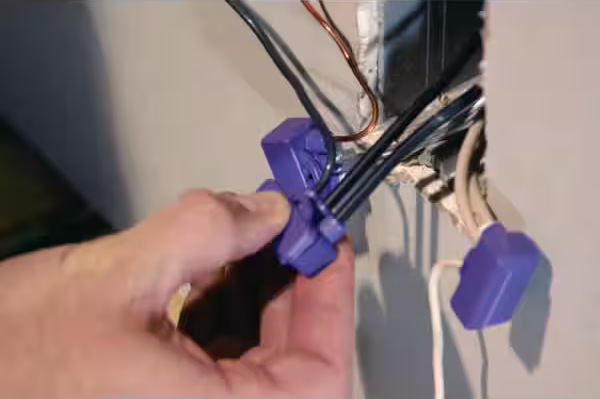
Twist-on “Purple Wire Nuts” (Ideal 65) are NOT a permanent CPSC-approved solution. They rely on spring tension, which fails as the aluminum deforms. We find these melted in renovation projects constantly.
The Remediation Hierarchy: Band-Aid vs. Cure
Many homeowners ask, “Can’t I just replace the outlets?” Unfortunately, no. The issue extends to every splice hidden in junction boxes. A partial fix often voids your home insurance policy. Our Residential Upgrades team handles the complete scope, ensuring no connection is left behind.
We see three types of fixes in the wild. Only one makes sense for the modern homeowner who wants to sell their home or switch insurance carriers.
| Method | CPSC Status | Our Verdict |
|---|---|---|
| CO/ALR Device Swap Replacing outlets/switches only. |
Conditional | Band-Aid. It leaves all light fixtures and junction boxes untouched. “Incomplete repair” per CPSC staff. |
| Purple Wire Nuts Twist-on pigtailing. |
Not Approved | Dangerous. High failure rate in field tests. We reject this method entirely. |
| AlumiConn Retrofit Torque-set lug connectors. |
Approved | The Standard. Permanent, secure, and insurance-accepted. Cost-effective relative to rewiring. |
| Full Copper Rewire New Romex everywhere. |
Gold Standard | Best, but Pricing. The ultimate fix, but costs $15k-$25k and destroys drywall. |
The AlumiConn Protocol
This isn’t a DIY project. It’s a precision retrofit. We use AlumiConn lugs because they separate the aluminum from the copper, preventing galvanic corrosion. But the connector is only as good as the installation. This is the cornerstone of effective Aluminum Wiring Remediation MN residents rely on.
Torque Matters
We don’t guess. We use calibrated torque screwdrivers set to exactly 10-15 inch-pounds (depending on wire gauge). This “cold welds” the wire without crushing it.
Box Fill
Adding connectors takes up space. We calculate “box fill” for every device. If the old metal box is too small, we install box extensions to prevent wire crowding and short circuits.
Dielectric Seal
Every port is pre-filled with silicone sealant. This encapsulates the aluminum, cutting off the oxygen supply and stopping oxidation dead in its tracks.
Insurance Reality: “Ordinance and Law”
In Minnesota, insurance carriers are increasingly issuing non-renewal notices for homes with unremediated aluminum wiring. But there’s a silver lining in your policy.
The Non-Renewal Risk
Carriers in Willmar and Montevideo are auditing older policies. Without a “Certificate of Remediation” from a licensed master electrician, you risk being dropped or forced into a high-risk pool.
Ordinance Coverage
Policy ProtectionCheck your policy for “Ordinance and Law” coverage. Recent MN case law (Great Northwest v. Campbell) reinforces that if a covered loss (like a small fire) occurs, this rider helps pay to bring the undamaged portion of the system up to code.
We Open Every Box. Every Time.
Generic home inspections simply spot-check visible outlets. That’s dangerous gambling.
Our Aluminum Safety Audit is exhaustive. We open every switch, every outlet, and every accessible junction box to verify the connection integrity. We provide a signed, detailed report you can hand directly to your insurance agent.
Schedule Your AuditAbout the Author
Chadwick Ferguson
Chadwick Ferguson is the owner and licensed Master Electrician behind Bright Haven Electric LLC, serving West Central Minnesota from his base in Milan, MN. With deep expertise in residential, commercial, and agricultural electrical systems, he specializes in modern energy solutions including Level 2 EV charger installations, automatic standby generators, and comprehensive electrical panel upgrades.
Chadwick is committed to providing safe, code-compliant, and reliable electrical work to his rural Minnesota community. As the author of the BHElectric blog, he shares practical insights and expert guidance to help homeowners and businesses navigate the complexities of their electrical systems.