
Spring Cabin Electrical Startup Guide — 12-Point Checklist | BHE
 Chadwick Ferguson
Apr 3, 2026
Chadwick Ferguson
Apr 3, 2026

Spring Cabin Electrical Startup Guide
A 12-point safety checklist from a licensed Minnesota electrician. Do not flip the main breaker without inspecting the system first.
Every spring, thousands of Minnesota cabin owners arrive, open the electrical panel, and throw the main breaker. Power comes on. Lights work. Everything seems fine — until it is not. A mouse chewed through Romex behind the kitchen wall. Freeze-thaw cracked an exterior outlet box. A dock GFCI failed silently over winter. Zero shock protection near water.
A proper spring cabin electrical startup takes about 30 minutes. It prevents house fires, shocks, and thousands of dollars in appliance damage. This guide matches the same 12-point inspection our team performs on seasonal properties across West Central Minnesota. You can do most of it yourself — and you will know when to call a pro.
Has your cabin been idle since last fall? Do not skip this. The electrical system endured a full Minnesota winter — no heat, no ventilation, no one watching. Treat the startup as the safety procedure it is.
Why a Spring Cabin Electrical Inspection Matters
Your primary residence stays heated, occupied, and monitored year-round. Your cabin does not. From November through April, it endures -30°F to 40°F temperature swings, ice loading, humidity shifts, and uninvited guests — rodents, squirrels, and raccoons — who chew your wiring for nesting material. Here is what that does:
Freeze-Thaw Damage
Repeated freeze-thaw cycles crack outlet boxes, shift conduit connections, and destroy weatherproof covers. Moisture trapped in a junction box since November loosens wire connections and corrodes terminals over five months. The service entrance and meter base are most vulnerable — ice loading can shift the mast away from the building.
Fire & Shock HazardRodent Wiring Damage
Mice and squirrels chew through Romex sheathing to access copper — or to wear down their teeth. A chewed wire in a wall cavity is an arc fault waiting to happen. That stripped insulation was the only barrier preventing a short circuit. One spark inside a wall full of mouse-nest material is all it takes to start a fire.
Arc Fault & Fire RiskPower Surge Exposure
If utility service stayed connected over winter, your cabin absorbed every outage, brownout, and voltage spike from ice storms. Without a whole-house surge protector, those transients hit your wiring and appliances directly. A damaged compressor or pump board may not show symptoms until you use the appliance.
Hidden Appliance DamageMoisture Intrusion
Unheated cabins accumulate condensation on cold surfaces — inside panels, junction boxes, and outlet enclosures. Moisture on bus bars and breaker terminals causes corrosion and arcing. If water entered through a damaged roof or window, a professional must inspect the wiring before you energize those circuits. Water and electricity never mix.
Do Not Energize Wet Circuits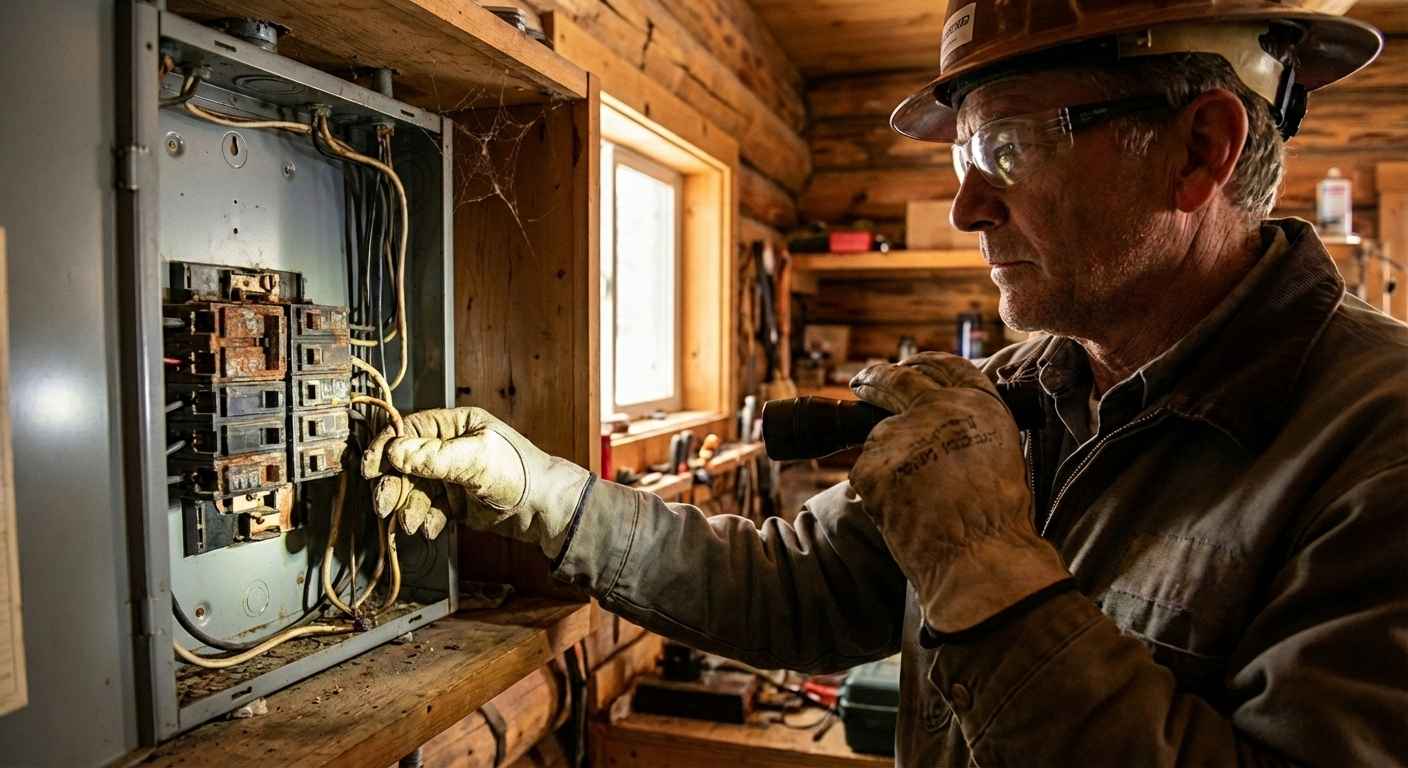
The 12-Point Spring Cabin Electrical Startup Checklist
This is the same checklist our crew follows for every spring cabin electrical startup. Work through it in order — each step builds on the last. Do not flip breakers until the visual inspections are complete.
Phase 1: Visual Inspection (Before Touching Breakers)
Inspect First — Power On Later
Complete these steps before anyone sleeps in the cabin. If any step reveals a problem, stop and call a licensed electrician.
- Walk the exterior and inspect the service entrance. Check the weatherhead, service mast, and meter base for ice damage or corrosion. Look for sagging wires, cracked brackets, or gaps between the mast and building. If the mast has shifted, do not energize — your utility may refuse reconnection until a contractor repairs it.
- Inspect the electrical panel before touching any breakers. Open the panel door. Look for moisture, corrosion, rust on bus bars, rodent evidence, and burning smells. Confirm all breakers are OFF. Standing water inside the panel? Stop immediately and call a licensed electrician.
- Check for rodent damage in accessible wiring areas. Inspect the attic, crawlspace, and basement for chewed insulation, droppings, and nesting material. Mice chew Romex consistently. The damage is often hidden. Look behind appliances and inside utility closets.
- Examine all exterior outlets and covers. Open every weatherproof cover on outdoor receptacles. Check for cracks, corrosion, and moisture. Replace damaged covers before energizing those circuits. Dock and lakeshore outlets are most vulnerable.
Phase 2: Gradual Power-Up
Energize Step by Step
Turn on circuits one at a time. This isolates faults and prevents cascading damage.
- Turn on the main breaker only — leave branch circuits off. Listen for buzzing, humming, or arcing at the panel. If the main trips immediately, do not re-engage it. A downstream fault requires professional diagnosis.
- Activate branch circuits one at a time. Turn on each breaker and wait 15–30 seconds. Start with lighting, then outlets, then heavy loads (well pump, water heater, HVAC). If a breaker trips, leave it off and move on.
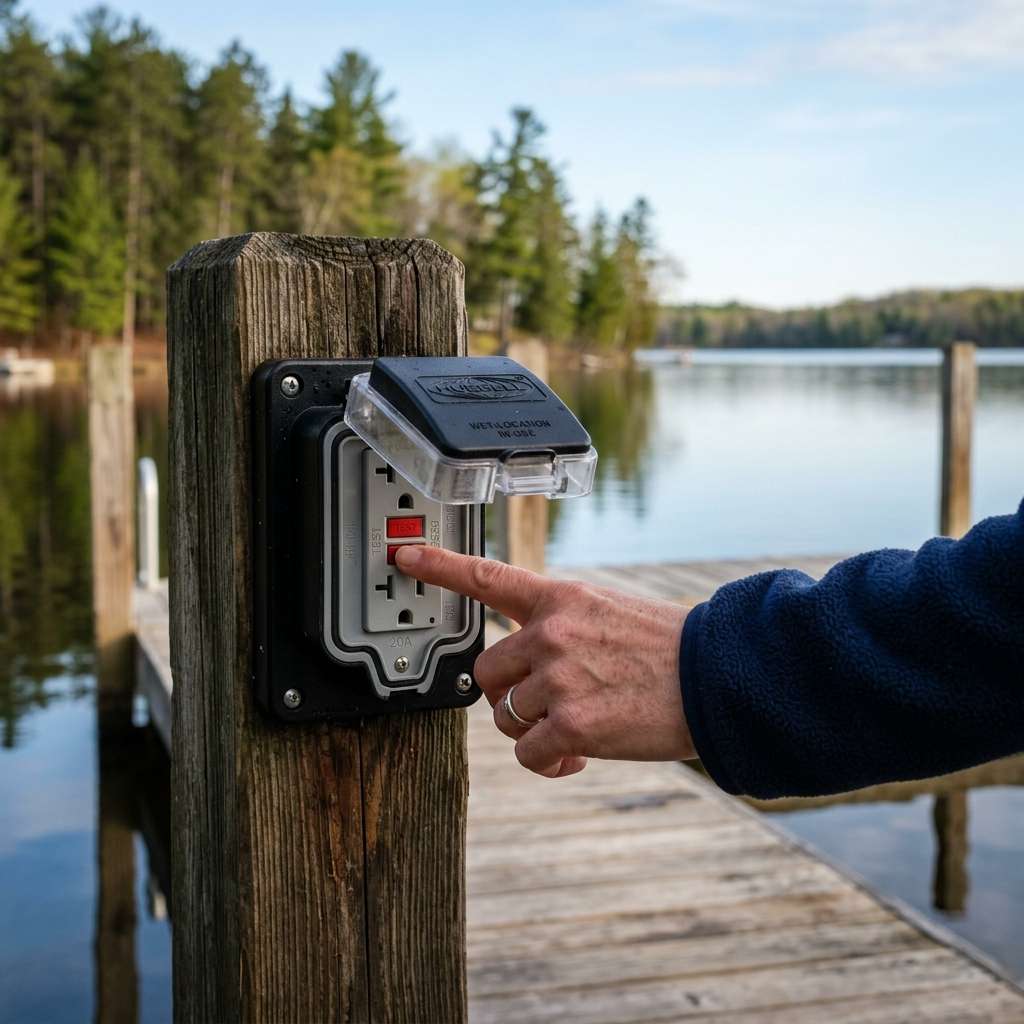
- Test every GFCI outlet and GFCI breaker. Press TEST on every GFCI outlet — kitchen, bath, exterior, garage, dock, and any outlet near water. It should trip instantly. Press RESET to restore. A GFCI that will not trip has failed. Replace it before using that circuit.
- Test all smoke detectors and CO alarms. Press the test button on every smoke and CO detector. Replace all batteries — even working ones. Batteries stored unheated for six months are unreliable. Replace detectors older than 10 years (smoke) or 7 years (CO).
Phase 3: Systems, Dock, and Final Checks
Verify Critical Systems
These final steps cover infrastructure, waterfront safety, and documentation.
- Verify well pump and septic circuits. If you are on a private well and septic system, energize those circuits. Confirm the well pump builds pressure normally. Short cycling means a pressure switch or bladder problem. Check the control box for tripped overloads.
- Inspect dock and shoreline electrical equipment. Before energizing dock, boat lift, or shoreline circuits, inspect all wiring and receptacles visually. Look for storm damage and ice-heaved posts. Dock circuits require GFCI protection — confirm it works before anyone enters the water.
- Check surge protection and test appliances. A whole-house surge protector with a green LED is active. Red or off means the module absorbed a surge — replace it. Plug in appliances one at a time. Watch for issues: a fridge that runs but won’t cool, a heater that trips, or flickering lights.
- Document everything. Write down issues, label tripped breakers, and note any fixtures that failed. Record the inspection date for next year’s baseline. If you found problems, call an electrician before occupying the cabin. Do not use faulted circuits.
“The worst cabin fires we respond to start the same way — someone opens up in the spring, throws the main breaker without looking first, and energizes a circuit that has been compromised all winter. Thirty minutes of inspection prevents that. Every single time.” — Chadwick Ferguson, Master Electrician & Co-Owner, Bright Haven Electric LLC
When to Stop and Call a Licensed Electrician
Most cabin owners can safely complete this checklist. But some conditions require a licensed professional. Attempting DIY repair risks electrocution, fire, or further damage. If you encounter any of these, stop, turn off the circuit, and call us:
Stop — Call an Electrician Immediately
- Standing water inside the electrical panel — indicates a serious moisture intrusion path that has compromised the service equipment
- Burn marks, melted plastic, or burning smell at the panel — evidence of arcing or overheating that occurred while the cabin was unoccupied
- Service mast physically shifted or separated from the building — the utility connection is compromised and may need to be rebuilt before reconnection
- Main breaker trips immediately upon engagement — indicates a downstream fault (short circuit or ground fault) that must be located and repaired
- Any breaker trips repeatedly when activated — the circuit has a persistent fault, potentially from rodent damage, water intrusion, or a failed appliance
- Outlets or switches that feel warm to the touch — heat at a device indicates a loose connection, overloaded circuit, or damaged wiring behind the device
- Visible rodent damage to wiring — chewed insulation on any conductor is a fire hazard and requires professional repair, not tape
- Buzzing, crackling, or arcing sounds — audible electrical noise from walls, panels, or outlets indicates an active fault that could ignite at any time
- GFCI outlets that will not trip or reset — failed ground fault protection near water is a life-threatening shock hazard, especially on dock and exterior circuits
Important Reminder — Do Not Use Damaged Circuits
- Do not re-engage a breaker that has tripped twice on the same circuit — the fault is real and it will not fix itself
- Do not use electrical tape to repair chewed or damaged wiring — the repair must meet NEC code requirements
- Do not stand in water or on damp ground while operating electrical equipment
- If you are unsure about any condition you find, leave the circuit off and let a professional evaluate it — that is always the right call
Remote Monitoring — Protect Your Cabin Year-Round
The best time to prevent winter damage is during the winter — not after. Modern remote monitoring lets you watch your property from anywhere. Know about problems before they become emergencies. Here are the systems we install for cabin owners:
WiFi Freeze Alarms & Temperature Monitors
A WiFi-connected temperature sensor sends an alert to your phone when the cabin interior drops below a set threshold — typically 40°F. This gives you time to respond before pipes freeze and burst, which prevents both water damage and the electrical hazards that follow when water contacts wiring. Units like the Temp Stick and MarCELL work on cellular networks where WiFi is unavailable.
Prevent Freeze DamageSmart Thermostats & HVAC Monitoring
A smart thermostat lets you maintain a 45–50°F setpoint remotely to prevent freezing. It alerts you if the system stops or temperatures drop. Combined with off-peak rates from your electric cooperative, this approach is surprisingly affordable.
Remote Climate ControlPower Outage Notification
A cellular-based power monitor alerts you when utility power is lost at the cabin — and again when it is restored. Knowing about an outage in real time lets you assess the risk: a 2-hour outage in October is inconsequential, but a 48-hour outage in January with no heat backup means frozen pipes and potential water damage to your electrical system. Early notification gives you options.
Real-Time AlertsSecurity Cameras & Smart Sensors
Internet-connected cameras and door/window sensors provide both security and property monitoring. Motion alerts let you know if someone — or something — is at the cabin when it should be empty. Some camera systems also detect water leaks and unusual temperature changes. We install wired and wireless camera systems designed for seasonal properties with intermittent connectivity.
Security & MonitoringNo Internet at Your Cabin? No Problem
Many cabins in Big Stone, Lac qui Parle, and Pope counties lack reliable broadband. Cellular devices like the MarCELL HW-003 use 4G LTE — no WiFi or landline needed. They run on AC power with battery backup. If power fails, they alert you until the battery depletes. We help cabin owners choose the right solution.
Bright Haven Electric installs and configures remote monitoring systems as part of our seasonal cabin electrical services. We handle the electrical connections, device placement, and network configuration so you get reliable alerts without the guesswork.
Closing the Loop — Fall Shutdown Matters Too
A proper spring startup is dramatically easier when the cabin was properly shut down the previous fall. Here is the short version of what a good fall electrical shutdown looks like — we will publish a complete fall shutdown guide before the end of the season:
Fall Shutdown Essentials
- Turn off all branch circuit breakers individually — do not just kill the main; turning off individual breakers lets you verify each one in the spring
- Unplug all appliances and electronics — prevents surge damage from winter outages and eliminates phantom loads
- Drain water systems and winterize plumbing — prevents pipe bursts that damage the wiring in affected areas
- Set mouse traps and seal entry points — rodent prevention is the single most effective way to protect cabin wiring over winter
- Install or verify remote monitoring equipment — so you know about problems before they become emergencies
- Test and replace smoke and CO detector batteries — even if the cabin will be empty, working detectors protect against an undetected electrical fire
- Document your shutdown — take photos of the panel (breakers off), record which circuits were active, and note any maintenance items for spring
Cabin Country Electricians — West Central Minnesota
Bright Haven Electric LLC provides spring cabin inspections, remote monitoring, and full seasonal electrical services across West Central Minnesota lake country. Our service area has some of the highest seasonal property concentrations in the state. We understand the unique electrical challenges that come with them.
We serve seasonal homeowners at properties on Big Stone Lake, Lac qui Parle Lake, Lake Emily, Pomme de Terre Lake, Lake Minnewaska, Lake Andrew, Eagle Lake, and dozens of smaller lakes and seasonal communities across our 10-county service area.
Whether you need a full spring startup inspection, a single GFCI replacement on the dock, or a complete remote monitoring system to protect your cabin year-round — we are here. We live in this community, we serve this community, and we take care of it the same way we take care of our own property at Bright Haven Farm.
Schedule Your Spring Cabin Startup Inspection
Opening your cabin this spring? Let a licensed electrician verify that your electrical system survived the winter before you flip the main breaker. Fast. Thorough. One less thing to worry about on opening weekend.
About the Author
Chadwick Ferguson
Chadwick Ferguson is the owner and licensed Master Electrician behind Bright Haven Electric LLC, serving West Central Minnesota from his base in Milan, MN. With deep expertise in residential, commercial, and agricultural electrical systems, he specializes in modern energy solutions including Level 2 EV charger installations, automatic standby generators, and comprehensive electrical panel upgrades.
Chadwick is committed to providing safe, code-compliant, and reliable electrical work to his rural Minnesota community. As the author of the BHElectric blog, he shares practical insights and expert guidance to help homeowners and businesses navigate the complexities of their electrical systems.