
Home EV Charger Installation FAQ & How-To
 Chadwick Ferguson
Mar 27, 2026
Chadwick Ferguson
Mar 27, 2026
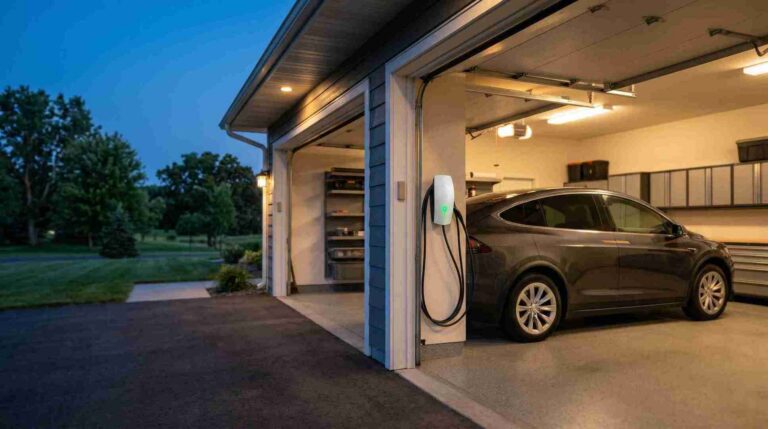
Ditch the Gas Station — Charge at Home
Gas prices keep climbing. A home EV charger installation lets you wake up to a full battery every morning — for a fraction of what you’d pay at the pump. Here’s everything you need to know.
Read more in: Residential Service Upgrades, Off-Peak Energy Savings
A home EV charger installation is the single most important upgrade for any EV owner. Instead of crawling along at 3 to 5 miles of range per hour on a wall outlet, a Level 2 charger adds 30 to 45 miles per hour. As a result, you plug in after dinner and wake up to a full battery. In addition, off-peak charging rates from your local co-op can cut your nightly fuel cost to just a few dollars.
Level 1 vs. Level 2 Home EV Charger Installation
Every EV comes with a basic Level 1 cord that plugs into a standard 120-volt outlet. While it technically works, it is painfully slow for daily drivers. Consequently, most homeowners choose a Level 2 charger. It uses a 240-volt circuit — the same voltage as your electric dryer — and is the standard for home charging.
Charging Speed Breakdown
Level 1 (120V — Standard Outlet):
Adds about 3 to 5 miles of range per hour. For example, a depleted 60 kWh battery takes roughly 50+ hours to fully charge. In other words, your car stays plugged in for over two full days. Therefore, Level 1 is only practical for plug-in hybrids or as a backup.
Level 2 (240V — Dedicated Circuit):
In contrast, a Level 2 charger adds approximately 30 to 45 miles of range per hour depending on the amperage. The same 60 kWh battery that takes 50+ hours on Level 1 charges fully in just 6 to 8 hours on a Level 2 charger. Furthermore, you can program your car or charger to begin charging at 10 PM when off-peak rates kick in.
Pro Tip: Most EV owners never charge from zero to full. A typical evening plug-in adds back 30 to 60 miles. That takes about 1 to 2 hours on Level 2. As a result, the charger becomes invisible in your routine.
Home EV Charger Installation Pays for Itself
The financial case for a home EV charger installation is strong — especially with gas prices trending upward. As a result, more homeowners are switching. Below is a cost comparison for driving 270 miles:
Gasoline
~$31.50
9 gallons × $3.50/gal
30 MPG average
EV — Standard Rate
~$8–10
~70 kWh × $0.12/kWh
Typical MN residential rate
EV — Off-Peak Rate
~$3–5
~70 kWh × $0.04–0.06/kWh
Co-op off-peak schedule
Real Savings: Driving 12,000 miles per year? Switching to off-peak EV charging saves roughly $1,100 to $1,200 per year in fuel costs. Furthermore, the charger install typically pays for itself within 12 to 18 months.
What Your Electrician Checks Before an EV Charger Install
A home EV charger installation is not a plug-and-play project. A Level 2 charger draws 30 to 60 amps continuously for hours. As a result, your electrician must confirm your home can handle the load. Specifically, a professional electrical safety audit covers these items.
Professional Load Calculation
- Panel Amperage: Your main breaker rating (100A, 150A, or 200A) determines how much total capacity you have. In particular, homes with 100-amp service often require an upgrade to safely support a Level 2 charger alongside existing circuits.
- Available Breaker Space: A Level 2 EV charger requires a dedicated double-pole breaker (typically 40A or 50A). As a result, your electrician will check whether your panel has open slots — or whether tandem breakers or a sub-panel are needed.
- Wire Run Distance: The distance from your panel to the charger location determines the wire gauge and conduit requirements. Longer runs require heavier (and more expensive) copper conductors to prevent voltage drop.
- NEC Compliance: The National Electrical Code requires that EV charging circuits be sized at 125% of the charger’s maximum continuous load. For instance, a 40-amp charger requires a 50-amp breaker and corresponding wire gauge.
- Installation Method: Additionally, your electrician will recommend either a hardwired connection (permanent, cleaner, supports higher amperages) or a NEMA 14-50 outlet (flexible, allows charger portability). Both methods are code-compliant when installed correctly.
Why DIY Installation Is Dangerous
An EV charger draws heavy continuous amperage for hours. This is very different from the brief loads most household circuits handle. As a consequence, undersized wiring or an overloaded panel can create a hidden fire hazard. Moreover, many manufacturers require a licensed electrician to keep your warranty valid.
Bottom Line: A professional load calculation protects your home and preserves your warranties. At Bright Haven Electric, every install includes a load calculation and city permit.
Indoor vs. Outdoor Home EV Charger Installation
Many homeowners wonder: garage or exterior wall? In most cases, a garage install is simplest. It protects the charger from weather and shortens the wire run. However, outdoor-rated chargers (NEMA 4 or NEMA 3R) handle Minnesota winters without issue. Regardless of placement, you need a dedicated circuit with proper conduit.
Local Rebates — Save Up to $500
In addition to fuel savings, several electric cooperatives in West Central Minnesota offer substantial rebates for qualifying Level 2 EV charger installations. As a result, we regularly work with these providers and can help ensure your installation qualifies:
- Agralite Electric Cooperative — Up to $500 for qualifying installations
- Runestone Electric Association — Off-peak EV rate programs available
- Minnesota Valley Electric Cooperative (MVEC) — Rebate programs for Level 2 chargers
- Lyon-Lincoln Electric Cooperative — EV charger incentives available
- Kandiyohi Power Cooperative — Contact for current EV charger programs
For a detailed breakdown of all available programs, see our complete guide: EV Charger Rebates in West Central Minnesota.
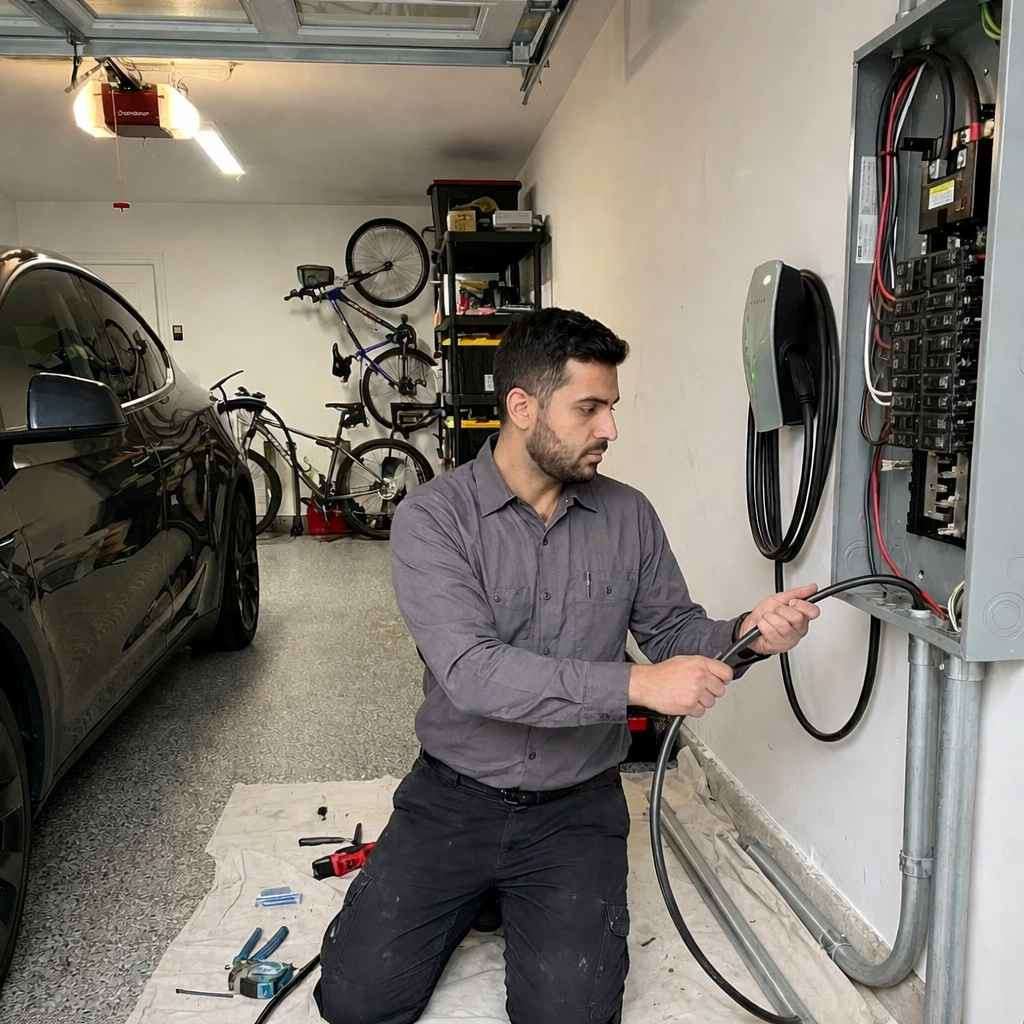
How to Evaluate Your Home for a Level 2 EV Charger
Time needed: 15 minutes
Before scheduling an EV charger installation, you can quickly evaluate your home’s electrical readiness yourself. This simple walkthrough helps you understand what your electrician will check and whether a panel upgrade might be necessary.
- Check your electrical panel’s amperage rating
First, locate the main breaker at the top of your electrical panel. It will be labeled with a number — typically 100A, 150A, or 200A. A Level 2 EV charger generally requires a dedicated 40A to 60A circuit. If you have 100-amp service, you will very likely need a panel upgrade before installation.
- Count available breaker slots
Next, open your panel door and count the empty breaker slots. A Level 2 EV charger needs a dedicated double-pole breaker, which occupies two slots. If your panel is completely full, your electrician may need to add a sub-panel or consolidate tandem breakers to create space.
- Measure the distance from panel to charging location
Then, estimate the distance from your breaker panel to where you plan to mount the charger — usually the garage wall closest to where you park. Longer wire runs require heavier gauge copper wire, which increases material cost. Keeping the charger as close to the panel as possible is the most cost-effective approach.
- Check for local co-op rebates
Furthermore, many electric cooperatives in West Central Minnesota offer up to $500 in rebates for qualifying Level 2 EV charger installations. Contact your provider — Agralite, Runestone, MVEC, or Lyon-Lincoln — to confirm eligibility before scheduling the work so you can maximize your savings.
- Schedule a professional load calculation
Finally, contact a licensed electrician to perform a formal load calculation. This calculation determines whether your panel can safely handle the added demand of an EV charger alongside your existing circuits — your HVAC, dryer, range, and water heater. This is the step that separates a safe installation from a dangerous one.
EV Charger Installation FAQ
A Level 1 charger is the cord that came with your car — it plugs into a standard 120-volt household outlet and only adds about 3 to 5 miles of range per hour. Realistically, that’s fine for a plug-in hybrid, but it’s painfully slow for a full-battery EV. A Level 2 charger runs on 240 volts (like your electric dryer) and adds 30 to 45 miles of range per hour. For most of my customers, that means plugging in when you get home and waking up to a full battery.
It depends on your current service size. If you have 200-amp service with available breaker space, we can usually install a Level 2 charger without touching the panel. But if you have older 100-amp service — which is still extremely common in West Central Minnesota — you will almost certainly need a service upgrade first. I always run a formal load calculation before quoting the job, so there are never surprises.
This is the number that gets people’s attention. At typical Minnesota residential rates (around $0.12 per kWh), charging a mid-size EV like a Tesla Model 3 costs roughly $8 to $10 for a full charge — that’s about 270 miles of range. The same distance in a gas-powered car averaging 30 MPG at $3.50 per gallon costs approximately $31.50. If you’re on an off-peak rate from your co-op, your EV charging cost drops even further — sometimes below $4 for a full charge.
Absolutely. Many of the chargers we install are outdoor-rated (NEMA 4 or NEMA 3R enclosures) and handle Minnesota winters without issue. We also install weatherproof NEMA 14-50 outlets for plug-in chargers. The key is proper conduit, a weatherproof disconnect, and making sure the unit is mounted on a solid surface out of the path of snowplows and roof runoff.
Yes. We install Tesla Wall Connectors, ChargePoint Home Flex, Emporia, JuiceBox, Grizzl-E, and pretty much any UL-listed Level 2 EVSE on the market. We’re also happy to recommend a charger based on your vehicle, your panel, and whether you want smart scheduling features or prefer a straightforward plug-and-go unit.
Yes — and they’re significant. Several local electric cooperatives offer up to $500 for qualifying Level 2 installations. We work with Agralite, Runestone, MVEC, Lyon-Lincoln, and Kandiyohi Power regularly and can help you navigate the paperwork. There may also be federal tax credits available depending on the year. I always recommend checking with your provider before scheduling so we can make sure the install qualifies. See our full breakdown: EV Charger Rebates in West Central Minnesota.
Related Guides
- EV Charger Rebates in West Central Minnesota — Full breakdown of local co-op rebate programs and eligibility requirements.
- Safe Home EV Charger Installation — NEC requirements, circuit sharing, and load management for EV charging.
- 200-Amp Service Upgrade Benefits — Why upgrading your panel unlocks EV charging, HVAC upgrades, and more.
- Save on Electricity Without Spending a Dime — Zero-cost strategies to reduce your overall energy bill.
- Understanding Your Home Electrical System — A full overview of panels, circuits, grounding, and more.
Ready to Charge at Home?
Stop paying $3.50+ per gallon. Bright Haven Electric installs Level 2 EV chargers throughout West Central Minnesota — including load calculations, permitting, and rebate assistance.
Licensed, Bonded, and Insured Master Electricians in West Central Minnesota
More on this topic:
Off-Peak EV Charging |
200A Service Upgrades |
EV Charger Rebates
About the Author
Chadwick Ferguson
Chadwick Ferguson is the owner and licensed Master Electrician behind Bright Haven Electric LLC, serving West Central Minnesota from his base in Milan, MN. With deep expertise in residential, commercial, and agricultural electrical systems, he specializes in modern energy solutions including Level 2 EV charger installations, automatic standby generators, and comprehensive electrical panel upgrades.
Chadwick is committed to providing safe, code-compliant, and reliable electrical work to his rural Minnesota community. As the author of the BHElectric blog, he shares practical insights and expert guidance to help homeowners and businesses navigate the complexities of their electrical systems.