
 Chadwick Ferguson
Apr 16, 2026
Chadwick Ferguson
Apr 16, 2026

Dock Electrical Safety & ESD Prevention
Electric shock drowning is invisible and fatal. Every Minnesota lake property owner needs to understand dock electrical hazards – and how to eliminate them before swim season.
Every summer, swimmers and boaters die in fresh water from a hazard they never saw. No warning. No visible sign. The water around a dock, marina, or boat lift carries an electrical current from a wiring fault – and anyone who enters that water is paralyzed by the shock before they can call for help. It’s called electric shock drowning (ESD), and it’s one of the most preventable causes of death in lake country.
Dock electrical safety isn’t optional. It isn’t something you check “when you get around to it.” Every dock, boat lift, shore power pedestal, and underwater light on your property is a potential source of lethal current – if the wiring isn’t installed correctly, protected by working GFCI devices, and inspected regularly. The National Electrical Code (NEC Articles 555, 680, and 682) exists specifically because people have died.
This guide covers how dock electrical faults happen, what electric shock drowning looks like from shore, the code-required protections every Minnesota dock installation must have, and the annual inspection you should schedule before anyone enters the water. We serve lake property owners across West Central Minnesota’s Big Stone Lake, Lac qui Parle Lake, Pomme de Terre Lake, Lake Minnewaska, and dozens of other bodies of water in our 10-county service area.
What Is Electric Shock Drowning?
Electric shock drowning occurs when AC electrical current leaks into the water surrounding a dock, marina, boat lift, or moored vessel. The current enters the water through a ground fault – a wiring defect that allows electricity to follow an unintended path. In fresh water, that unintended path runs through anyone in the water.
Fresh water is a poor conductor compared to the human body. When current leaks into fresh water, it preferentially flows through the body of a swimmer because the human body offers a lower-resistance path. The electrical current causes involuntary muscle contraction – the swimmer can’t move, can’t call for help, and drowns while still conscious. From the surface, it looks like a drowning. Rescuers who jump in to help are exposed to the same current.
The Mechanism
AC current as low as 10 milliamps can cause loss of muscle control in water. The swimmer can’t coordinate their limbs. They can’t keep their head above the surface. Even a strong swimmer is helpless – the current overrides voluntary muscle control. It takes just 100 milliamps across the heart to cause ventricular fibrillation. A single circuit with a ground fault can leak far more than that into the water surrounding a dock.
Lethal Below 100mAWhy It Is Invisible
There’s no visual cue. The water doesn’t bubble, change color, or look different. Voltage gradients in the water are undetectable without instrumentation. A swimmer enters the field, loses muscle control, and sinks. Witnesses see a person struggling and assume it’s a standard drowning. Many ESD deaths are classified as accidental drowning because the electrical cause is never investigated.
No Visible WarningWho Is at Risk
Anyone in the water near energized dock infrastructure. Children are particularly vulnerable because they swim closer to docks, ladders, and boat lifts – the areas where voltage gradients are strongest. Rescuers who jump in to help a struggling swimmer are exposed to the same current. Pets that swim near docks are equally at risk. The hazard zone extends up to 50 feet from a fault source in fresh water.
50-Foot Hazard ZoneFresh Water vs. Salt Water
Salt water is a far better conductor than the human body, so current in salt water flows through the water rather than through a swimmer. Fresh water – the water in every Minnesota lake – is a worse conductor than the body. Current in fresh water takes the path of least resistance: directly through anyone in it. This is why ESD is overwhelmingly a fresh water phenomenon, and why Minnesota’s lake country faces this risk specifically.
Fresh Water = Higher Risk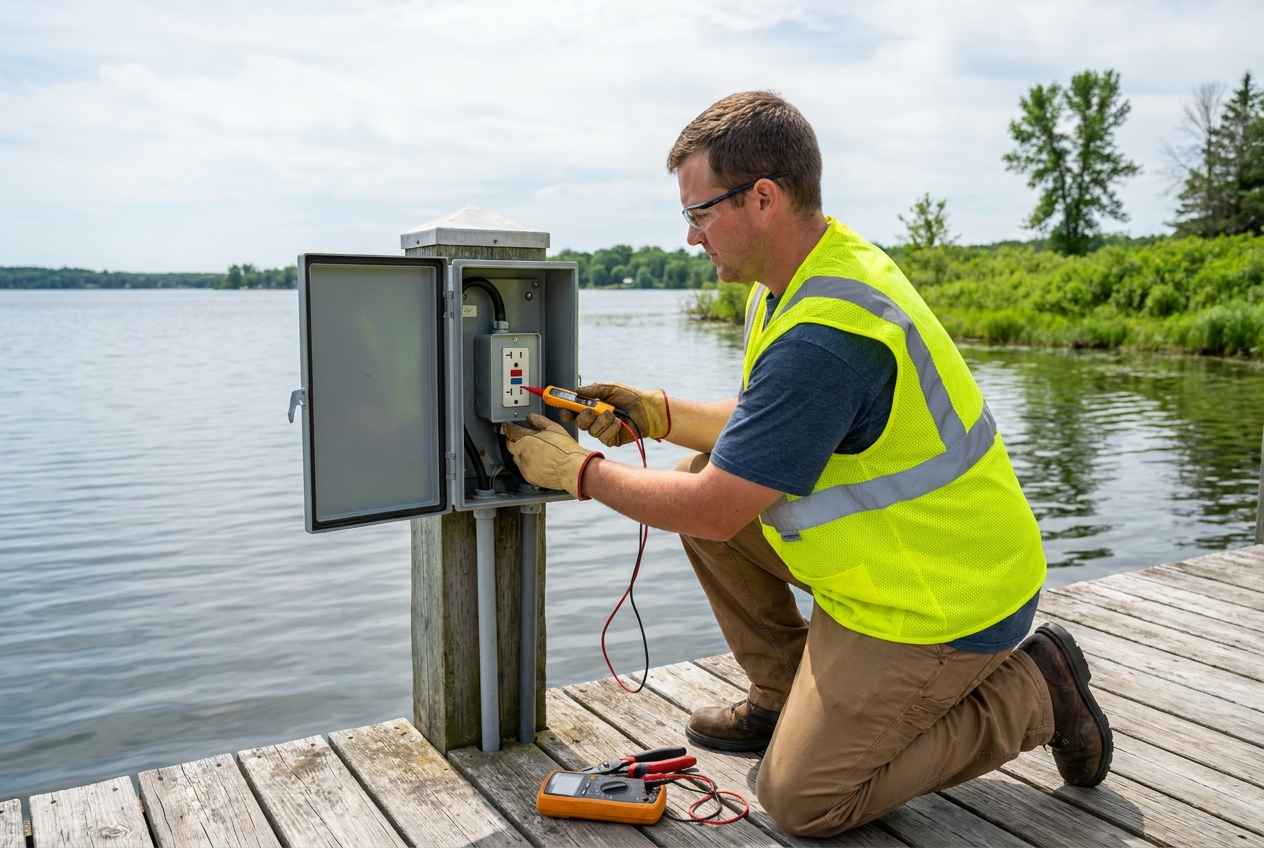
How Dock Electrical Faults Happen
Dock electrical systems operate in the harshest environment your property has – constant moisture, UV exposure, ice loading, wave action, and physical abuse from boats and equipment. Every component degrades faster than its land-based equivalent. Here are the most common fault sources we find during dock inspections in West Central Minnesota:
Damaged Wiring and Connections
UV-degraded cable jackets, corroded terminals, and loose connections in junction boxes are the most frequent fault sources. Ice heaving shifts dock posts, stressing conduit and pulling wires. Boats strike shore power pedestals. Extension cords – which are never code-compliant for permanent dock power – abrade against metal edges and develop conductor exposure. Any exposed conductor near water creates a direct leakage path into the lake.
Most Common FaultBoat and Lift Motor Faults
Submersible boat lift motors, bilge pumps, and shore power connections on vessels can develop insulation failures that leak current into the water through the hull or lift frame. A boat plugged into shore power with a failing hot-water heater element or pump motor can energize the water around the entire dock. The fault may originate on a neighbor’s boat – you can’t control every vessel at a shared dock.
Vessel-Sourced FaultUnderwater and Landscape Lighting
Underwater dock lights, underwater fishing lights, and shoreline landscape lighting operate submerged or at the waterline. Any enclosure failure, seal leak, or conductor breach puts voltage directly into the water at the precise location where people swim. Low-voltage LED lighting is safer but not risk-free – a failed transformer or improperly grounded system still presents a shock hazard.
Direct Water ContactFailed or Missing GFCI Protection
A GFCI (ground fault circuit interrupter) detects current leakage as low as 4 – 6 milliamps and trips the circuit in milliseconds. Without working GFCI protection, a ground fault on any dock circuit leaks current into the water indefinitely. GFCIs fail – especially in outdoor environments. A GFCI that doesn’t trip when you press the TEST button has failed. Every dock circuit requires GFCI protection, and every GFCI must be tested regularly.
Last Line of DefenseIf You Suspect Electrical Current in the Water
- Do NOT enter the water – if a swimmer appears to be struggling near a dock or marina without an obvious cause, don’t jump in. You’ll be exposed to the same current
- Turn off all dock power immediately – find the breaker panel and shut off every circuit that feeds the dock, lift, and shoreline
- Throw a flotation device – use a life ring, rope, or any non-conductive thrown object to reach the victim without entering the water
- Call 911 – report a suspected electric shock drowning so responders bring the right equipment and approach
- Don’t touch metal on the dock – metal rails, ladders, and dock frames may be energized if a ground fault is present
“I have seen docks wired with extension cords, indoor-rated wire, and outlets held together with electrical tape – all within arm’s reach of the water. Every one of those installations is a potential fatality waiting for a swimmer to walk down the dock on a wet day. Dock electrical work isn’t a DIY project. The consequences of getting it wrong aren’t a tripped breaker – they’re a funeral.” – Chadwick Ferguson, Master Electrician & Co-Owner, Bright Haven Electric LLC
NEC Requirements for Dock Electrical Safety
The National Electrical Code dedicates entire articles to electrical installations near water because the stakes are life and death. If your dock, boat lift, or shoreline power was installed without following these requirements, it isn’t merely “not up to code” – it’s a lethal hazard. Here are the key NEC provisions that govern dock electrical installations:
Key NEC Articles for Dock and Marina Electrical Systems
- NEC Article 555 – Marinas, Boatyards, and Commercial/Noncommercial Docking Facilities: Requires GFCI protection for all 15A and 20A, 125V receptacles. Requires ground fault protection for 30A and 50A shore power outlets. Specifies wiring methods, receptacle enclosure ratings, and equipment grounding conductor requirements for all dock circuits.
- NEC Article 680 – Swimming Pools, Fountains, and Similar Installations: Covers any body of water with electrical equipment – including dock areas with underwater lighting. Requires equipotential bonding of all metal within specified distances of the water’s edge.
- NEC Article 682 – Natural and Artificially Made Bodies of Water: Added specifically for lakes, ponds, and rivers. Requires GFCI protection for all electrical equipment used in, on, or within specified distances of the water. Addresses boat hoists, dock electrical supply, and waterside lighting installations.
- GFCI Protection Is Non-Negotiable: Every receptacle on a dock, every shore power outlet, every circuit feeding a boat lift motor, and every underwater or near-water lighting circuit must be GFCI-protected. The 2023 NEC expanded GFCI requirements even further. If your dock installation predates current code, it likely needs upgrades.
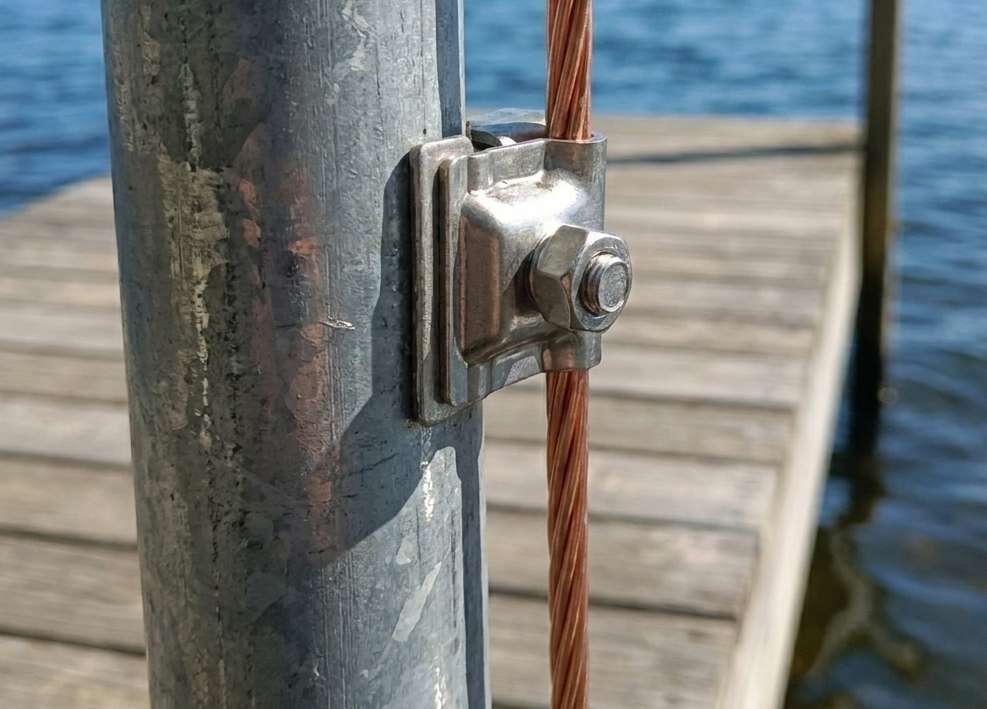
- Equipotential Bonding: All metal parts of the dock structure, boat lift, dock ladders, and shore power pedestals within the required distance of the water must be bonded together and connected to the equipment grounding conductor. This bonding equalizes voltage potential between metal surfaces so a person touching two different objects isn’t exposed to a voltage difference.
Annual Dock Electrical Inspection – What We Check
Every dock electrical system should be professionally inspected before swim season. Winter’s freeze-thaw, ice loading, and spring storms degrade dock wiring faster than any other installation on your property. This is the inspection our team performs on lakeshore and waterfront properties across our service area:
Dock Electrical Inspection Checklist
Pre-Season Dock Inspection Items
- Test all GFCI devices. Press TEST on every GFCI outlet and GFCI breaker that protects dock circuits. Verify each device trips and resets. Replace any GFCI that fails to trip – it has zero protective value.
- Inspect all wiring, conduit, and junction boxes. Walk every run of conduit and cable. Check for UV degradation, physical damage, loose fittings, and corrosion. Open all accessible junction boxes and inspect for moisture intrusion, corroded terminals, and rodent damage.
- Verify equipotential bonding. Confirm all metal components – dock frame, boat lift, ladders, rails, and pedestal enclosures – are bonded together and connected to the equipment grounding conductor. Test bonding connections for continuity and tightness.
- Inspect shore power pedestals and receptacles. Open every pedestal and outlet enclosure. Check for corrosion, water intrusion, heat damage, and loose connections. Verify weatherproof covers are intact and operational. Confirm receptacle ratings match the installed circuits.
- Test boat lift motor circuits. Inspect wiring to submersible and above-dock lift motors. Check disconnect switches, motor overload protection, and ground fault protection. Verify the motor is properly grounded through the frame bonding system.
- Inspect underwater and shoreline lighting. Check all underwater light fixtures for seal integrity, enclosure cracks, and wiring damage. Verify low-voltage transformer grounding. Inspect landscape lighting conduit and connections at the waterline where wave action causes the most damage.
- Measure voltage in the water (if instrumentation is available). Using a calibrated voltage tester with waterproof probes, measure voltage gradients in the water around the dock and lift with all circuits energized. Any measurable voltage in the water indicates a fault that must be located and repaired immediately.
- Document and recommend. Record the inspection findings, photograph any deficiencies, and provide a written report with repair recommendations and code compliance status.
Why Dock Electrical Work Is Not a DIY Project
We understand the impulse. You wire your own outlets in the garage. You installed a ceiling fan. You ran an extension cord from the cabin to the dock “just for the weekend.” But dock electrical work is fundamentally different from any other residential wiring project – and the margin for error is zero.
The Difference Between Indoor Wiring and Dock Wiring
Inside your home, a wiring mistake might trip a breaker, blow a fuse, or create a localized shock hazard. On a dock, a wiring mistake puts lethal current into the water – an environment where people swim, children play, and pets drink. There’s no second chance.
- Extension cords are never acceptable for permanent dock power – they degrade in UV, abrade against metal, and aren’t rated for wet locations. NEC prohibits their use as a substitute for permanent wiring.
- Indoor-rated wire and devices will fail outdoors – standard NM-B (Romex) cable, indoor outlets, and non-weatherproof junction boxes deteriorate within one season of dock exposure.
- Improper grounding kills – a dock circuit without proper equipment grounding and bonding sends fault current directly into the water. This is the primary mechanism of electric shock drowning.
- Permits exist to protect you – Minnesota requires electrical permits for dock wiring. The inspection process catches errors before they endanger anyone. Unpermitted dock work puts your family and your neighbors at risk.
Dock Electrical Systems We Install and Service
Bright Haven Electric designs and installs dock electrical systems that comply with current NEC requirements and are built to withstand Minnesota’s lake environment. If you need a new power pedestal, a boat lift circuit, or a complete shoreline power system, we handle it from permit to final inspection.
Shore Power Pedestals
Code-compliant shore power pedestals with 20A, 30A, and/or 50A receptacles, individual GFCI protection per circuit, and weatherproof enclosures rated for marine environments. We install pedestals from Eaton, Hubbell, and Midwest Electric – properly grounded, bonded, and permitted.
NEC 555 CompliantBoat Lift Motor Circuits
Dedicated circuits for electric boat lift motors – properly sized wire, appropriate disconnect, motor overload protection, and GFCI protection at the breaker. We ensure the lift frame is bonded into the dock’s equipotential bonding system. No extension cords. No undersized wire. No missing ground.
Properly ProtectedShoreline and Underwater Lighting
Low-voltage LED dock lighting, underwater accent lights, and shoreline pathway lighting designed for permanent installation in marine environments. We use marine-rated fixtures with properly grounded transformers, GFCI-protected supply circuits, and conduit runs that account for freeze-thaw and wave action.
Marine-RatedWinter Bubblers and De-Icing Systems
Dock bubblers and de-icing systems protect your dock and lift from ice damage, but they run submerged for months on end. We install bubbler circuits with GFCI protection, dedicated circuits, and properly rated wiring for year-round submersion. The wiring must be as resilient as the equipment it feeds.
Year-Round SubmersionLake Country Electricians – West Central Minnesota
Bright Haven Electric LLC provides dock electrical inspections, new dock power installations, boat lift wiring, shoreline lighting, and ESD prevention services across West Central Minnesota. Our service area covers the highest concentrations of seasonal and permanent lake properties in the region.
We serve lake property owners on Big Stone Lake, Lac qui Parle Lake, Lake Emily, Pomme de Terre Lake, Lake Minnewaska, Lake Andrew, Eagle Lake, Diamond Lake, and dozens of smaller seasonal lakes across our 10-county service area.
If your dock has never been professionally inspected, or if it was wired before current GFCI and bonding requirements, schedule an inspection before swim season. The cost of an inspection is trivial compared to what’s at stake.
Dock Electrical Safety FAQ
Below are the most common questions we hear about dock electrical safety and electric shock drowning prevention in Minnesota.
Electric shock drowning (ESD) occurs when AC electrical current leaks from a dock, marina, boat lift, or shore power connection into the surrounding water. In fresh water, the human body is a better conductor than the water itself, so the current flows through anyone swimming nearby. As little as 10 milliamps can cause involuntary muscle paralysis, preventing the victim from swimming or calling for help. The drowning appears ordinary from the surface – there are no bubbles, no visible signs, and no warning. ESD is almost exclusively a fresh water hazard because salt water conducts electricity better than the human body.
You can’t detect it without instrumentation. There are no visible signs – the water doesn’t change color, bubble, or look different. The only reliable detection method is to measure voltage gradients in the water using a calibrated AC voltage tester with waterproof probes. Warning signs that suggest a dock electrical fault include tingling sensations when touching the dock ladder or metal dock components, a GFCI that won’t reset, flickering dock lights, or a breaker that trips repeatedly. If a swimmer near your dock shows signs of distress without an obvious cause, suspect electrical current in the water immediately.
Per NEC Articles 555 and 682, all 15A and 20A, 125V receptacles on docks require GFCI protection. Shore power receptacles rated 30A and 50A also require ground fault protection. Boat lift motor circuits, underwater lighting circuits, and any circuit serving equipment within the code-specified distance of the water must be GFCI-protected. The 2023 NEC expanded these requirements further. If your dock was wired before current code, you likely need GFCI upgrades. Every GFCI on your dock should be tested monthly during the season by pressing the TEST button.
At minimum, once per year before swim season. Dock electrical systems operate in the harshest environment on your property – constant moisture, UV exposure, ice loading, freeze-thaw cycles, and physical impact from boats and equipment. Winter alone can crack outlet enclosures, corrode connections, shift conduit, and cause GFCI failures. A professional inspection includes testing all GFCI devices, verifying equipotential bonding, inspecting wiring and connections, and checking boat lift motor circuits. The inspection takes about an hour and catches problems before they endanger anyone.
Dock electrical work requires a licensed electrician and an electrical permit in Minnesota. This isn’t a recommendation – it’s a legal requirement and a safety imperative. Dock wiring involves NEC Articles 555, 680, and 682, which specify materials, methods, GFCI protection, bonding requirements, and installation practices that are far more demanding than standard residential wiring. A wiring mistake inside your house trips a breaker. A wiring mistake on your dock puts lethal current into the water where people swim. The permit and inspection process exists to catch errors before they endanger lives.
Equipotential bonding connects all metal components of your dock – the dock frame, boat lift, ladders, rails, and shore power pedestal enclosures – together with a bonding conductor, which is then connected to the equipment grounding system. This creates an equal electrical potential across all metal surfaces. Without bonding, a fault on one metal component could create a voltage difference between it and another metal part. A person touching both simultaneously – stepping off a metal ladder onto a metal dock while holding a metal railing – would become the current path. Bonding eliminates that voltage difference and is required by NEC for dock installations.
Schedule Your Dock Electrical Inspection
Don’t put swimmers in the water until you know the dock is safe. A professional inspection verifies GFCI protection, bonding, wiring integrity, and code compliance – before anyone enters the lake.
About the Author
Chadwick Ferguson
Chadwick Ferguson is the owner and licensed Master Electrician behind Bright Haven Electric LLC, serving West Central Minnesota from his base in Milan, MN. With deep expertise in residential, commercial, and agricultural electrical systems, he specializes in modern energy solutions including Level 2 EV charger installations, automatic standby generators, and comprehensive electrical panel upgrades.
Chadwick is committed to providing safe, code-compliant, and reliable electrical work to his rural Minnesota community. As the author of the BHElectric blog, he shares practical insights and expert guidance to help homeowners and businesses navigate the complexities of their electrical systems.